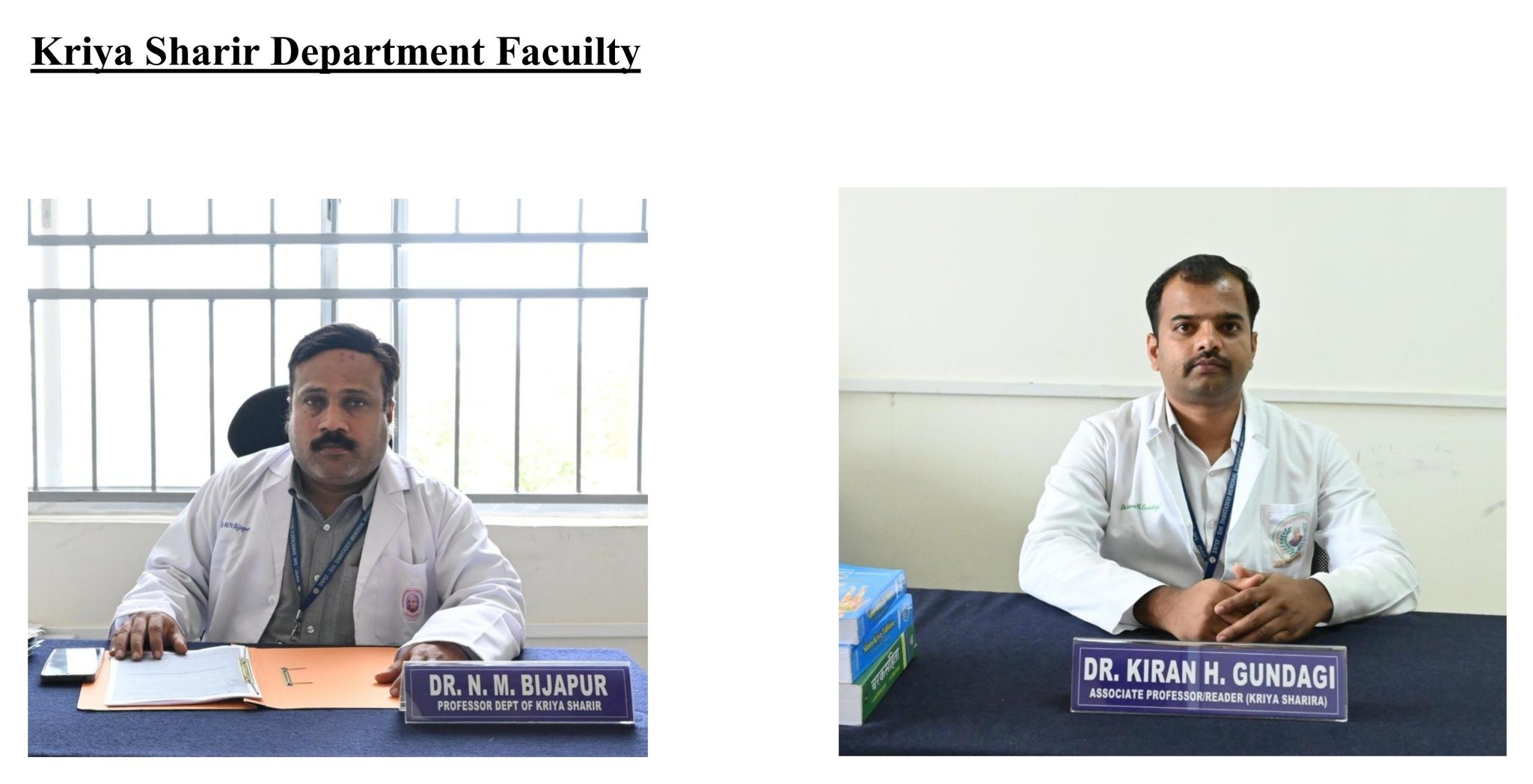
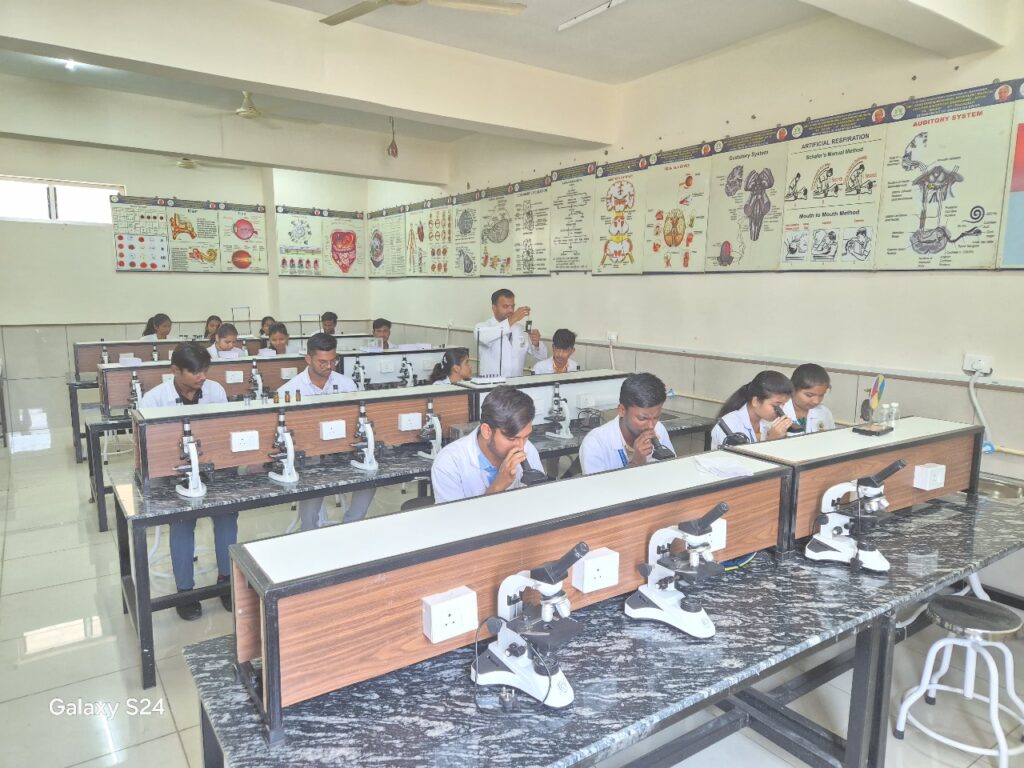
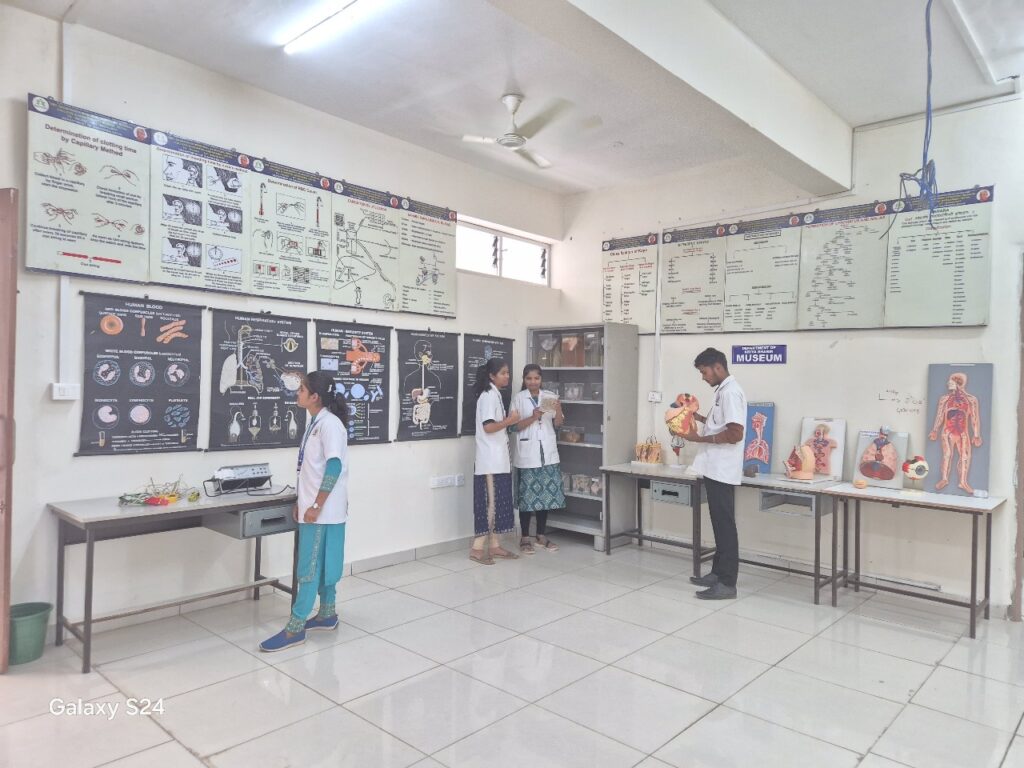
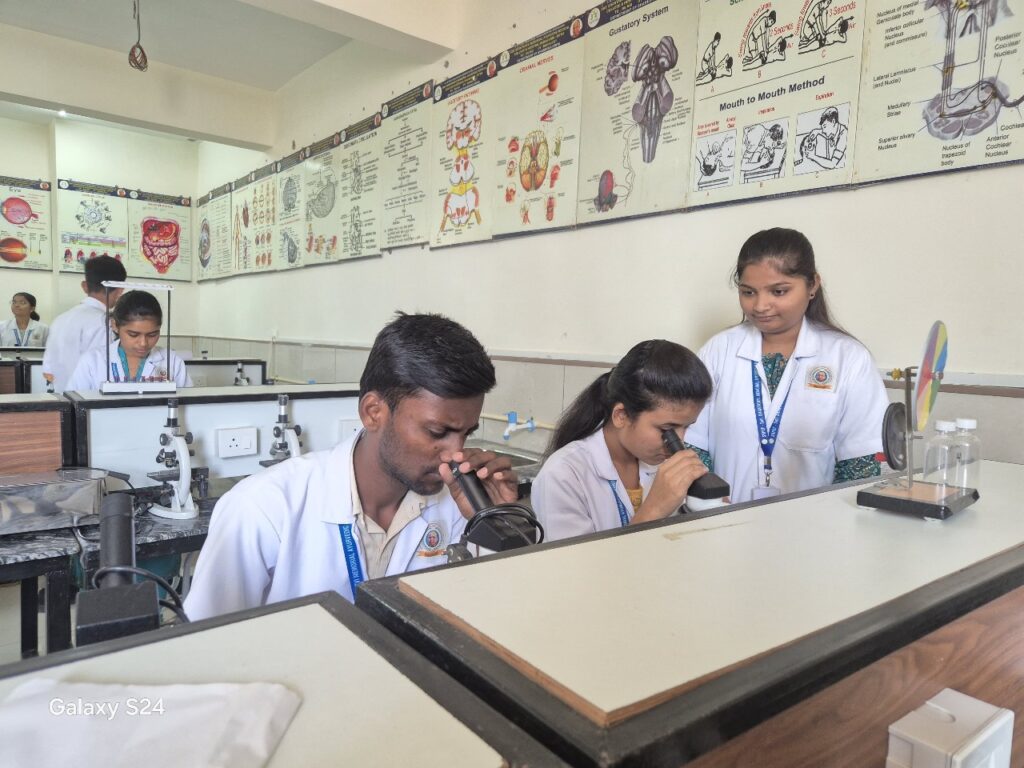
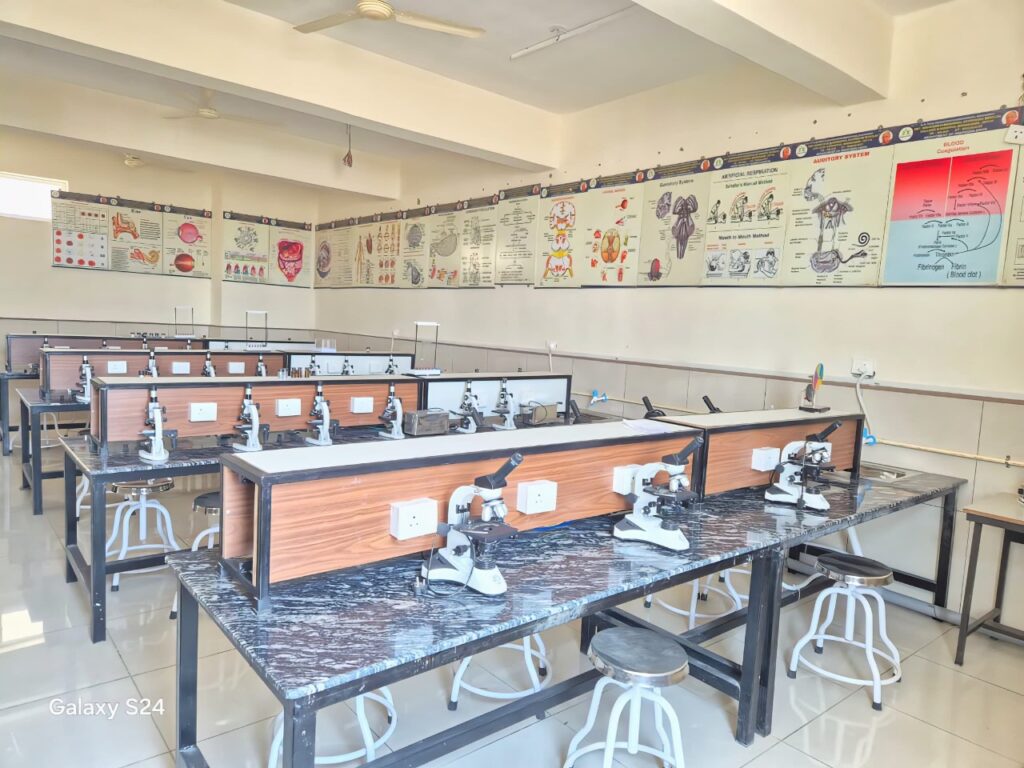
1) Department Of Kriyashareera
The Vision of the Department of Sharira Kriya (Physiology) in an Ayurveda institution is typically:
“To achieve excellence in teaching, research, and application of Ayurvedic physiology by integrating classical knowledge with modern scientific advancements, fostering a deep understanding of human body functions, and contributing to the holistic development of healthcare.
The Mission of the Department of Sharira Kriya (Physiology) can be outlined as follows:
1. Quality Education – To impart comprehensive knowledge of Ayurvedic physiology (Sharira Kriya) by integrating classical Ayurvedic principles with modern scientific understanding.
2. Research & Innovation – To encourage research in Ayurvedic physiology and explore its correlation with contemporary medical sciences for evidence-based validation.
3. Practical Application – To enhance students’ clinical understanding by applying physiological principles in Ayurvedic diagnostics and treatment.
4. Holistic Development – To cultivate critical thinking, ethical practice, and professional competence among students for their role as future Ayurvedic practitioners and researchers.
5. Community Contribution – To promote awareness of Ayurveda’s physiological concepts in healthcare and contribute to the well-being of society through academic and outreach programs.
2 ) Department of Shareera Rachana
VISION OF DEPARTMENT
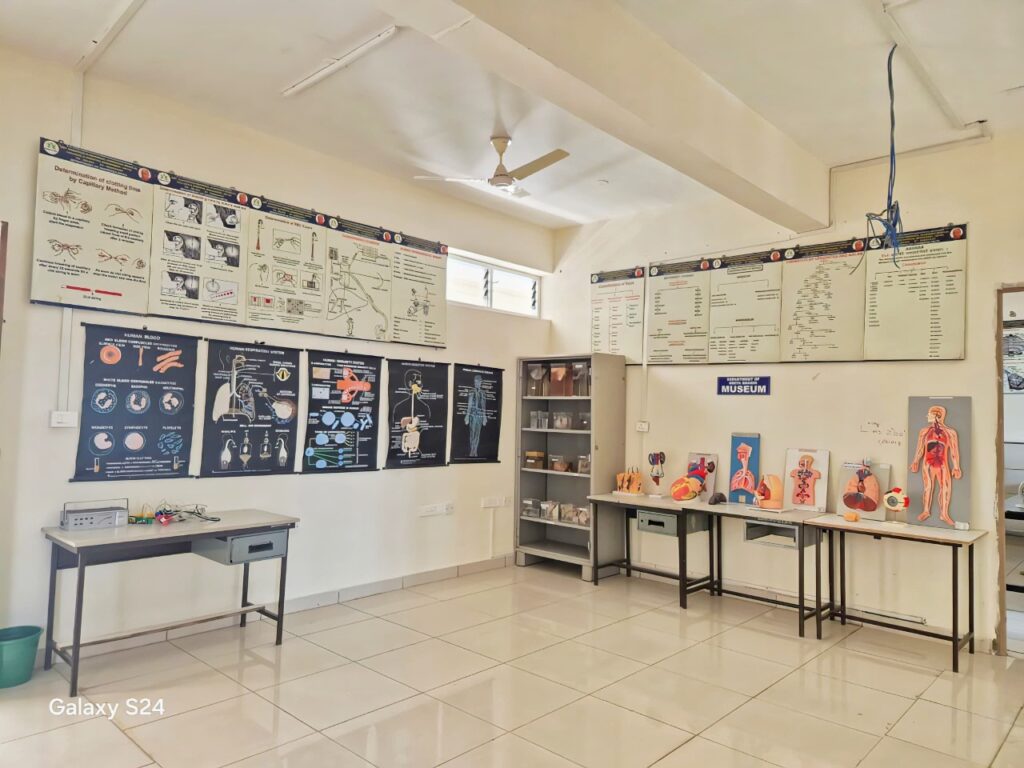
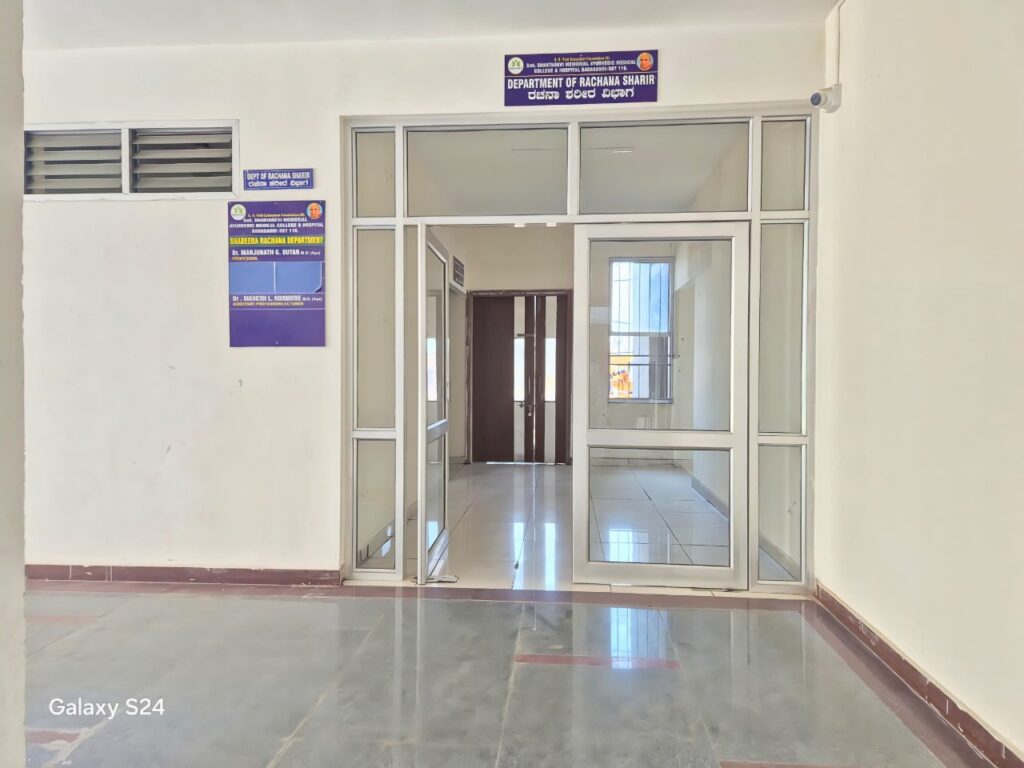
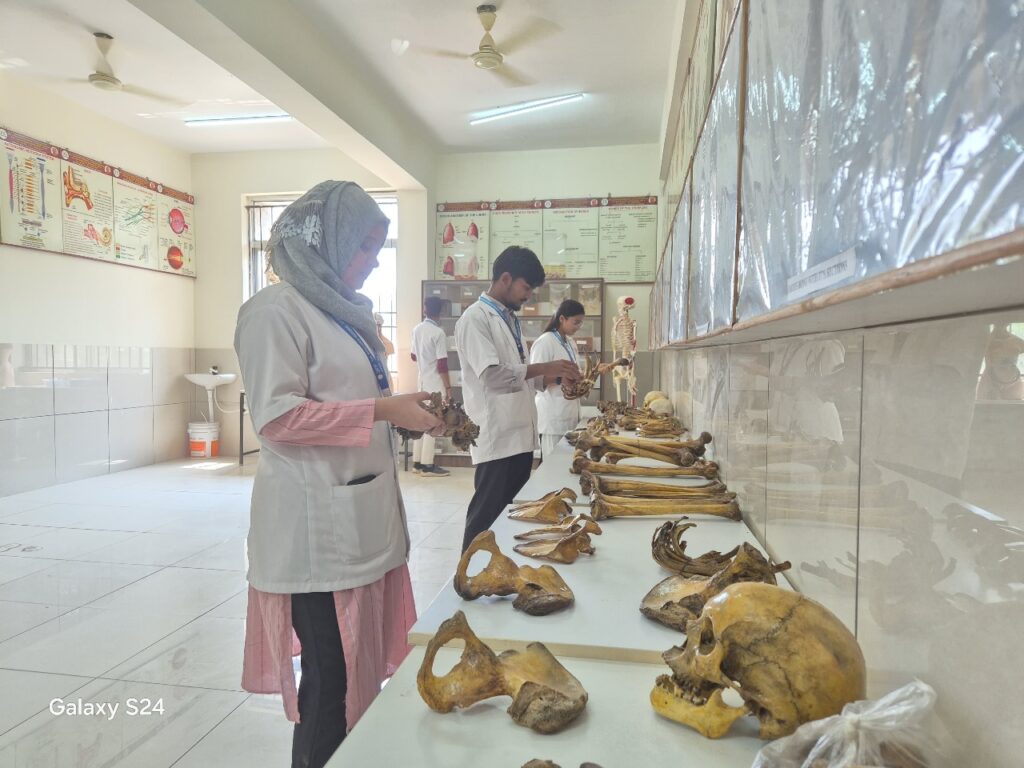
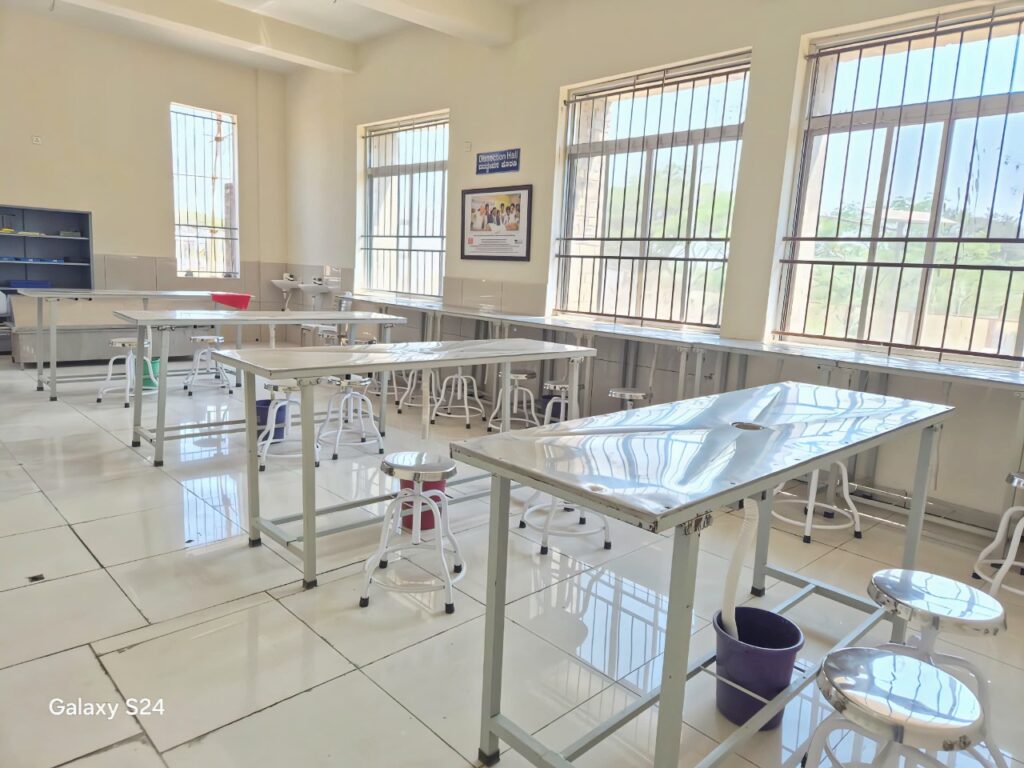
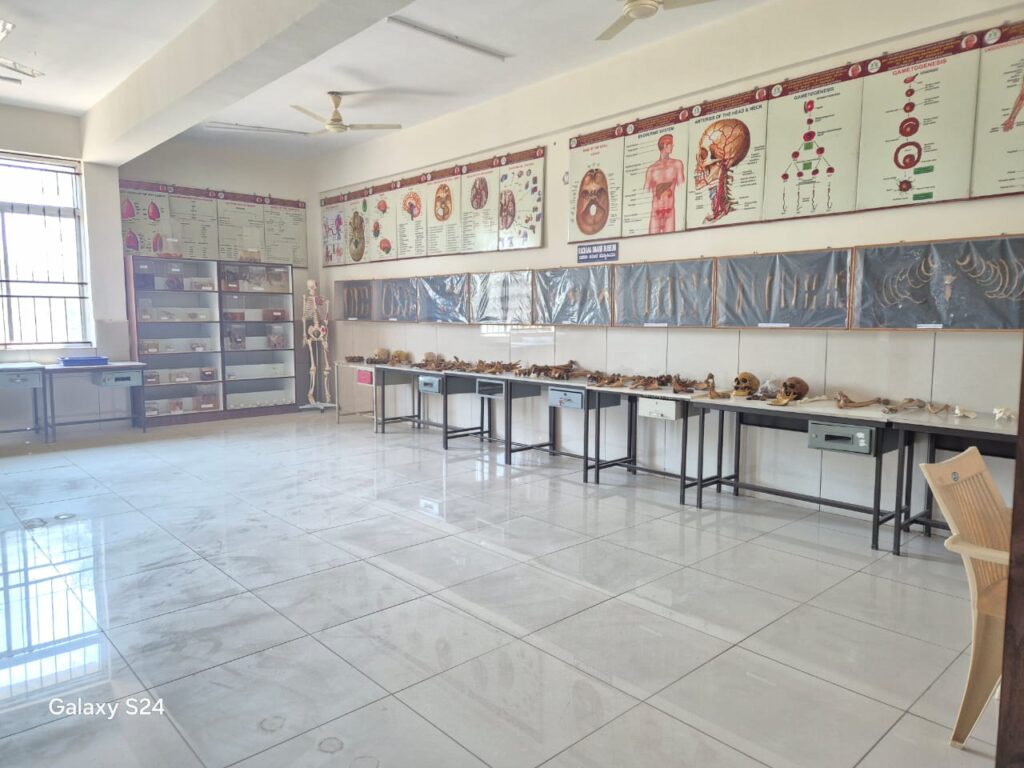
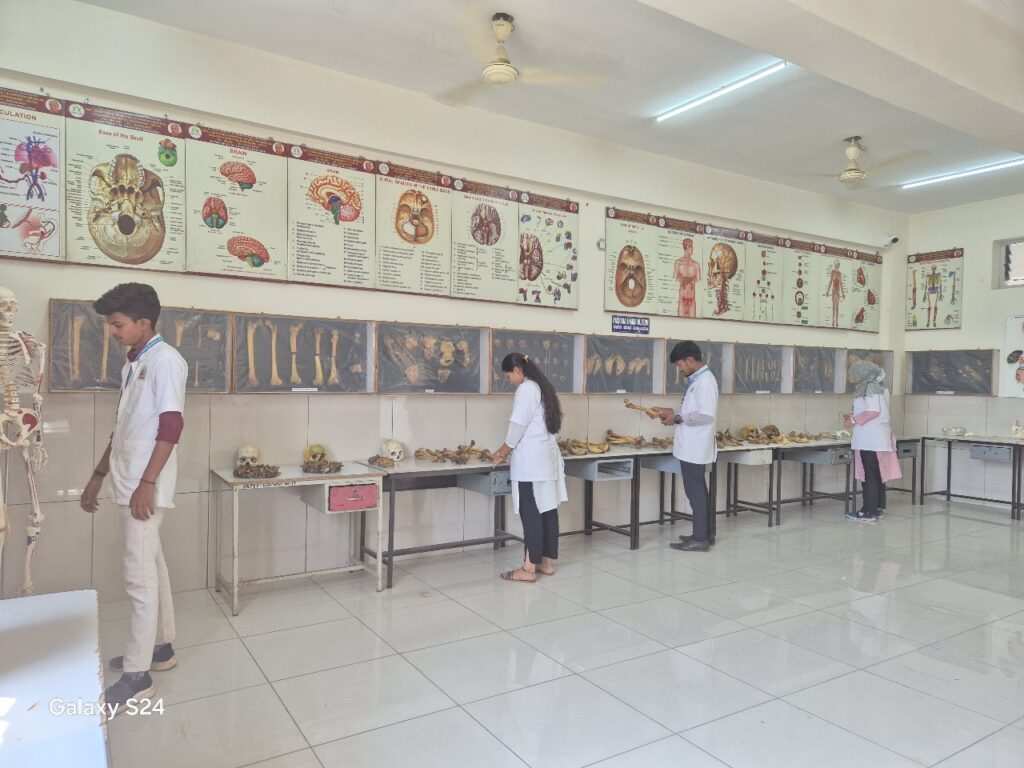
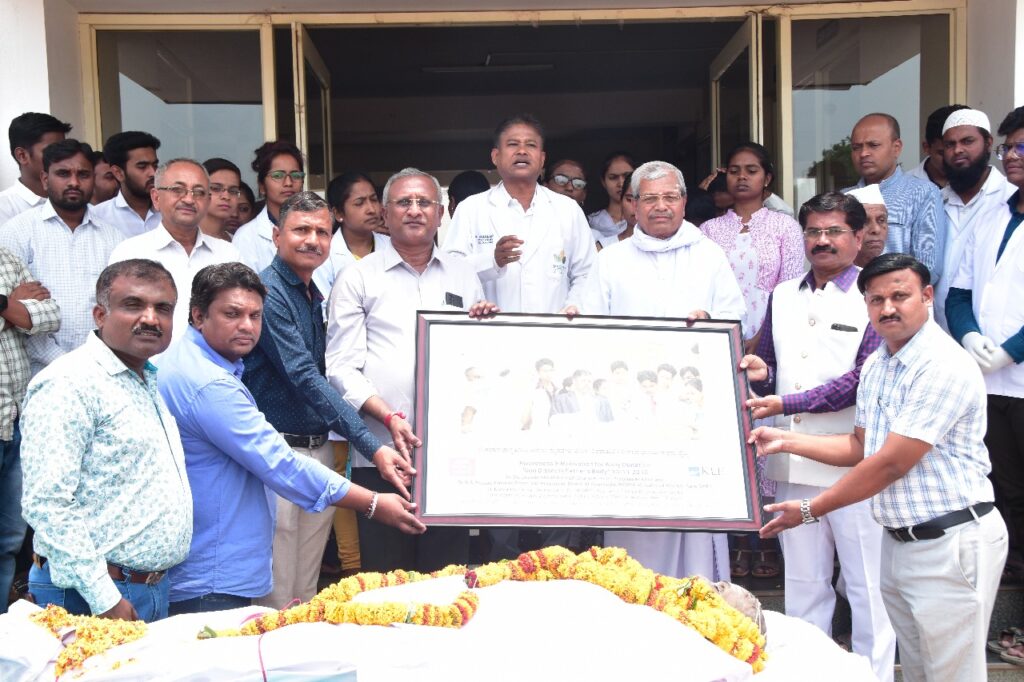
INTRODUCTION:-Rachana Sharir is the subject that deals with the structural knowledge of the human body. Here, students learn human Anatomy with theoretical as well as practical aspect. We have spacious department along with museum which is full with various specimens, charts, models. Apart from this, we also have a dissection hall wherein students get the practical knowledge of the human body by performing cadaveric dissection.
- Every student who has got admission to our college should get acquainted with the subject by all means.
MISSION OF DEPARTMENT
- To develop fulfilled Rachana Sharir department following the norms of NCISM and get ready to transfer the knowledge of the subject to fore coming intake of hundred students.
OBJECTIVES
- To set the department in such a way that all the students taking admission to this college will be bestowed with all the resources required for attaining knowledge in the subject of Rachana Sharir.
- Every student should get theoretical and practical knowledge at par.
- To develop students’ creative as well as analytical thinking process while studying the subject.
TEACHING AND LEARNING METHODS USED BY DEPARTMENT :-We are practicing student centric teaching-learning method in our department. we use various teaching-learning methods like,
- Demonstration
- Model making
- Audio Visuals Aids
- Group discussion
- Shloka recitation
- Problem-based learning
- Case-based learning
- Self-directed learning
BENEFITS TO STUDENTS:-With the help of various teaching-learning methods that we use definitely arose interest in the subject. Students learn the subject in an easy way.
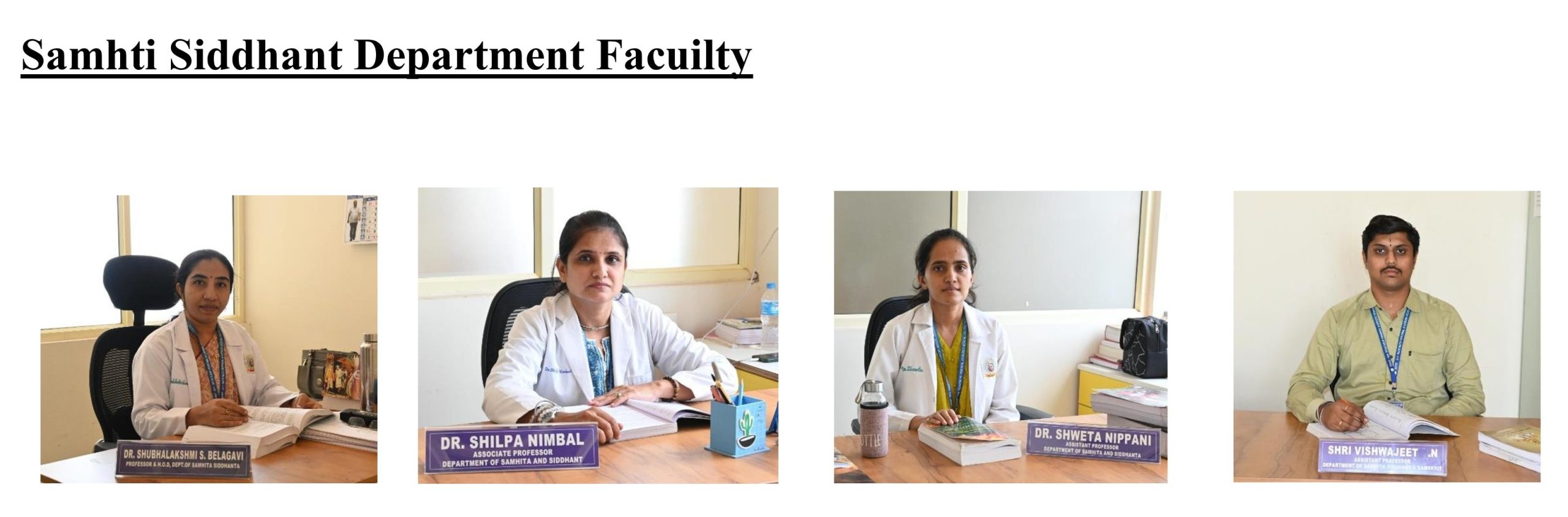
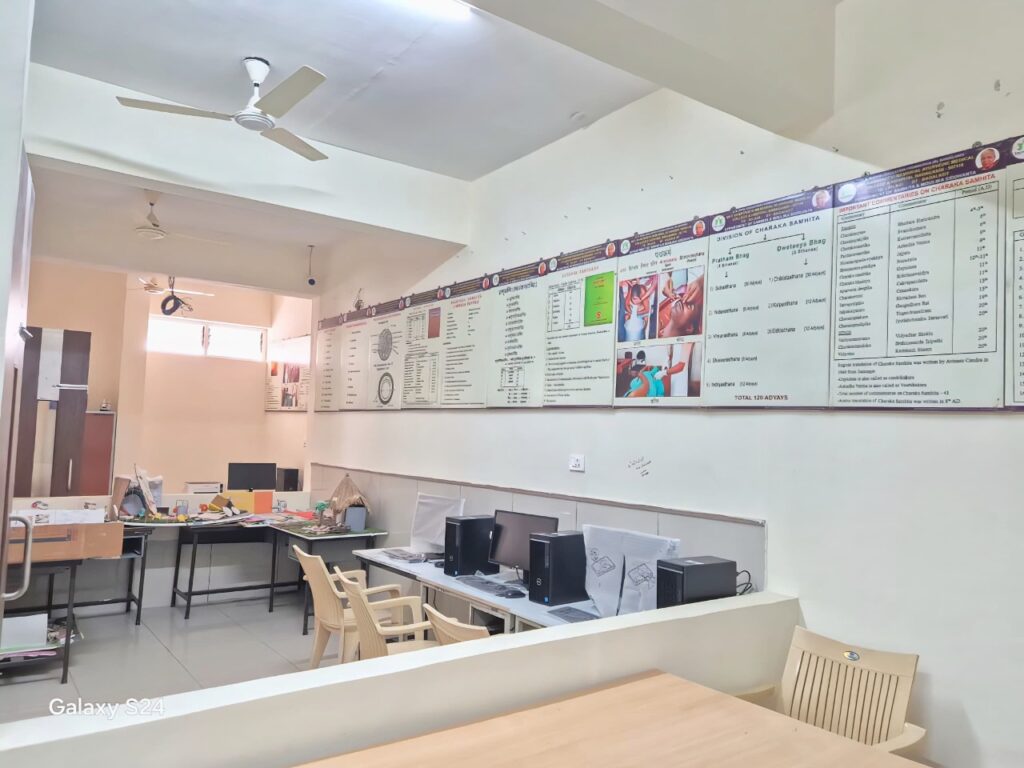
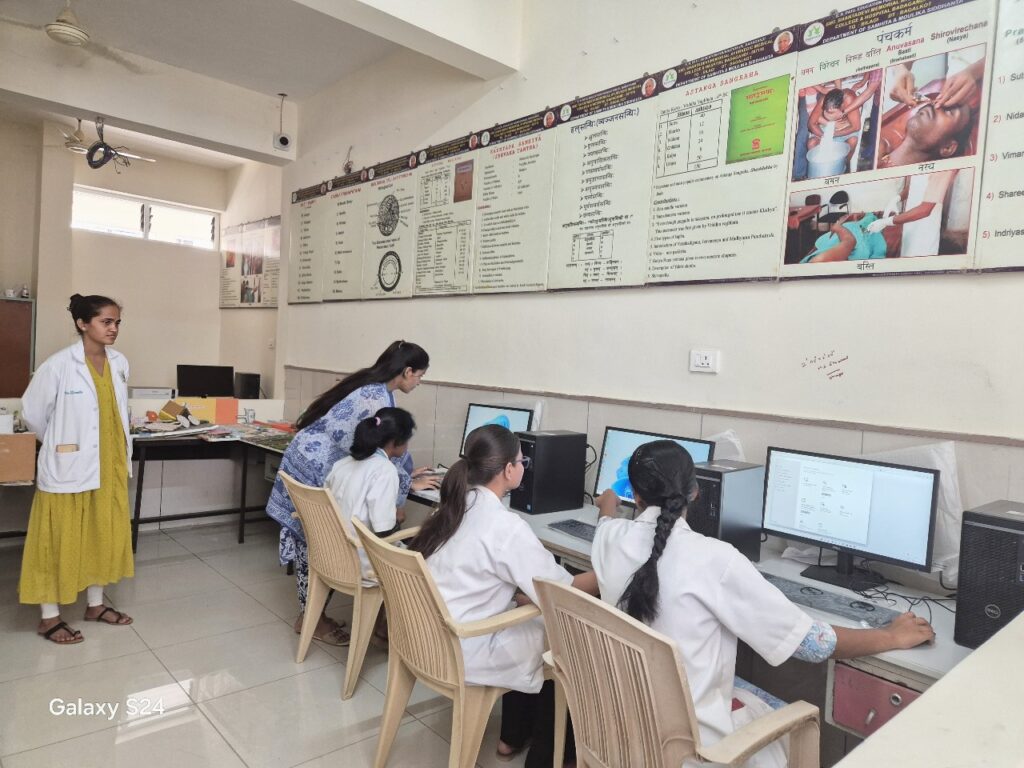
3) Department of Ayurveda Samhitha & Siddhantha
INTRODUCTION : Our subject includes 3 major aspect of learning tools namely
- Sanskrit & Ayurved Itihas : Ayurveda originated as of vedic sciences. All original texts of Ayurveda science in Sanskrit so, the knowledge of Sanskrit language is compulsory to learn Ayurveda .This subject includes Sanskrit grammar which is necessary for reading & understanding various samhitas (Original Ayurvedic Texts) through which student gains thorough knowledge of Ayurvedic science.In Ayurvedic Itihas part the history of rich culture of Ayurveda from its origin upto recent era is explained.
- Samhita Adhyayana : This subject provides complete knowledge of ancient Ayurvdic texts namely Charak Samhita, Ashtang hridaya, Sushruta Samhita, for betterment of human life in context to achieve complete health. In this subject ideal behavioral patterns for human beings according to day(dinacharya), seasons(ritucharya), causative factors of diseases(hetu), Diagnosis of diseases(nidan), complete treatment of disease(chikitsa),etc. is explained in detailed manner.
- Padarth Vidnyan : This subject deals with knowledge of composition & functioning of human body through like Panchmahabhuta(five basic elements), kaal(time, age, season), disha (directions), Aatma (knowledge of human soul), Mann(psychological aspect).This subject also deals with explaining different philosophical aspects (Darshana) regarding human behavioral pattern.
VISION OF DEPARTMENT:-To deliver perfect knowledge of Ayurvedic classical text to each students in simpler & practical form.
MISSION OF DEPARTMENT :-To develop perfect ayurvedic physicians by providing complete & undoubted knowledge from samhitas along with practical demonstration.
OBJECTIVES:-
- To acquire theoretical as well as practical knowledge of ancient & classical ayurvedic texts (samhitas)
- To compare & corelate knowledge from different classical Ayurvedic texts with current era in simpler language form for easy understanding for students.
- To bring confluence in achieving academic excellence and promoting scientific research methods in enlighten knowledge of Samhitas.
TEACHING & LEARNING METHODS USED BY DEPARTMENT:
- Audio visual Aids
- Tutorials
- Shloka recitation
- Group discussion
- Practical demonstration
BENEFITS TO STUDENTS:-Due to effective use of all the teaching tools students gets complete theoretical as well as practical knowledge regarding ayurveda as a health science. This will helps to develop perfect Ayurvedic physicians.
2nd Year Professional Departments
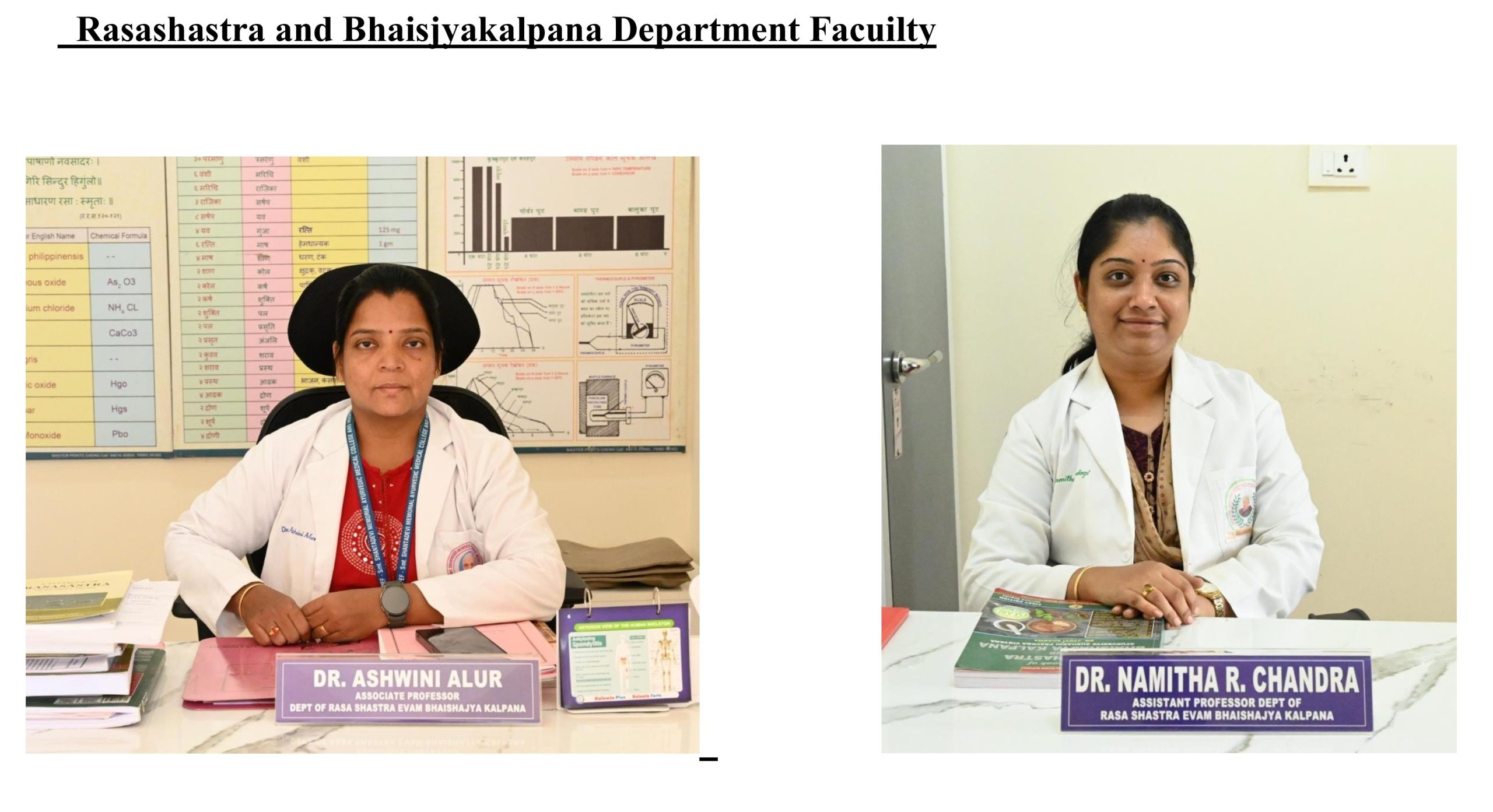
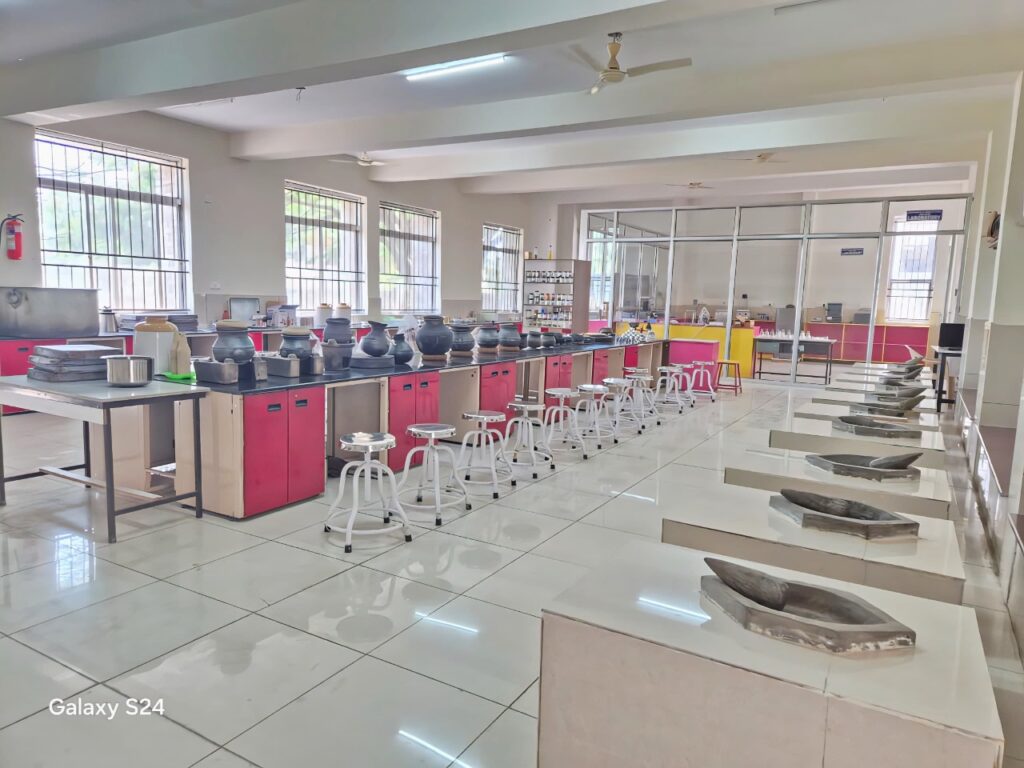
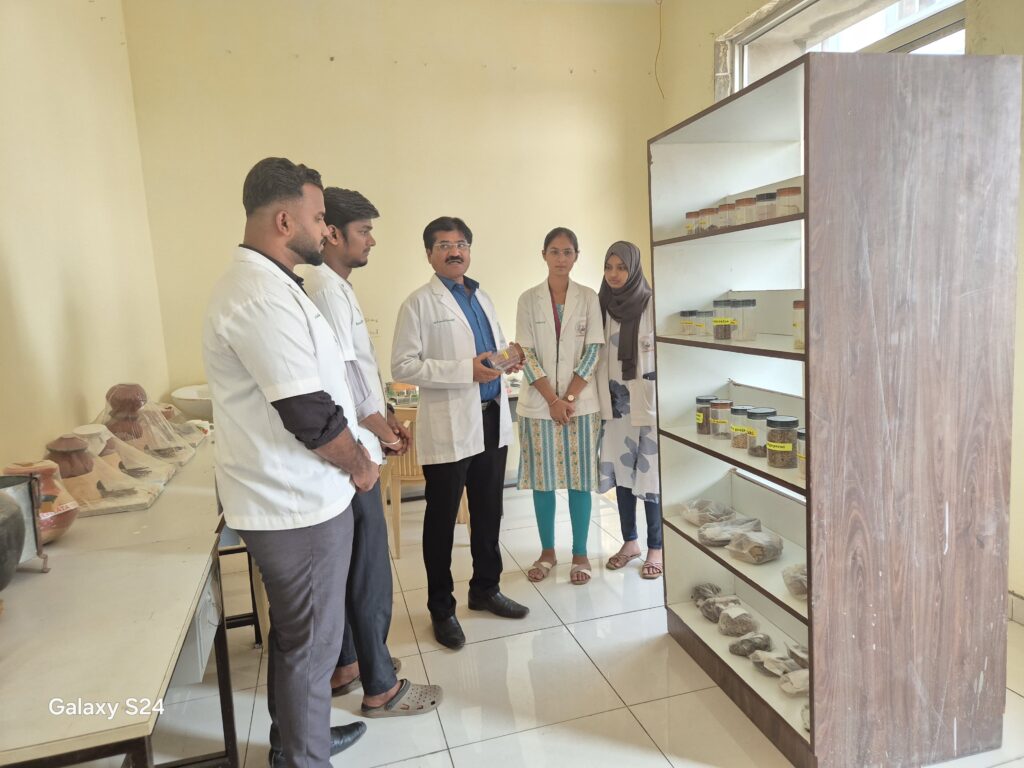
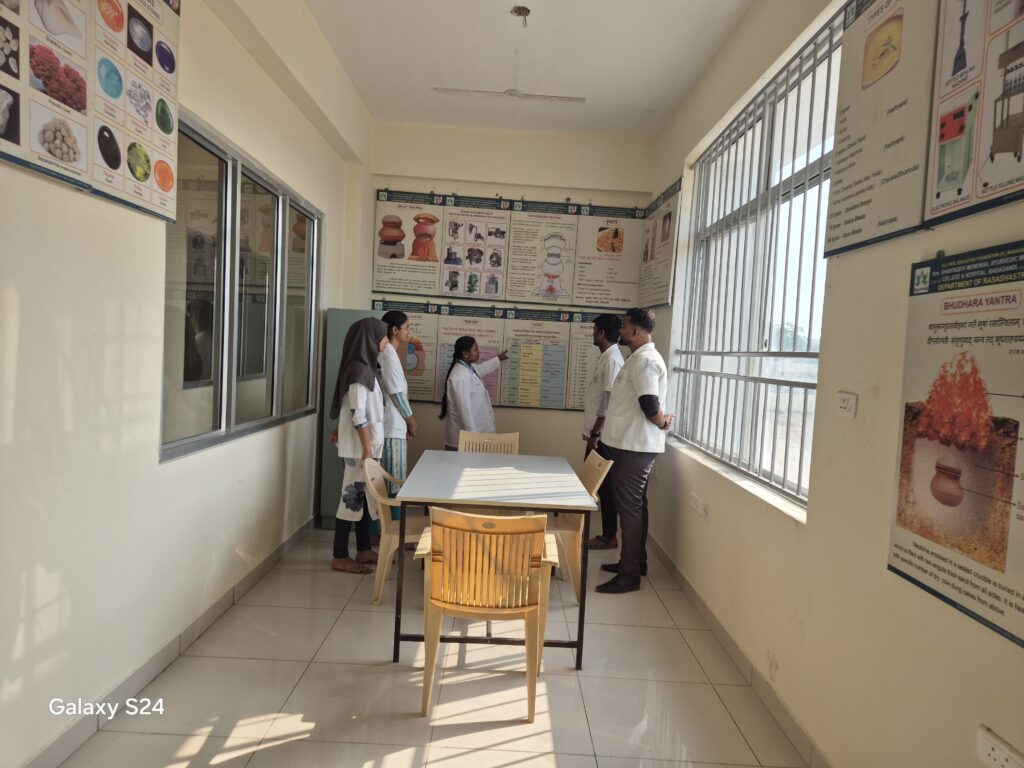
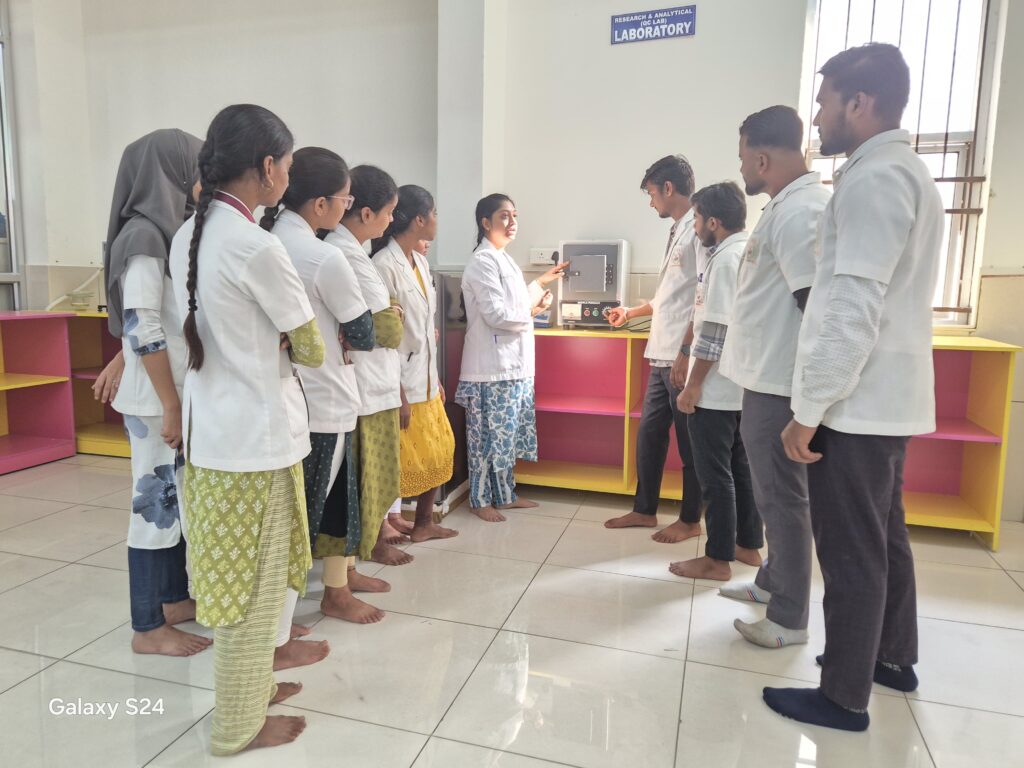
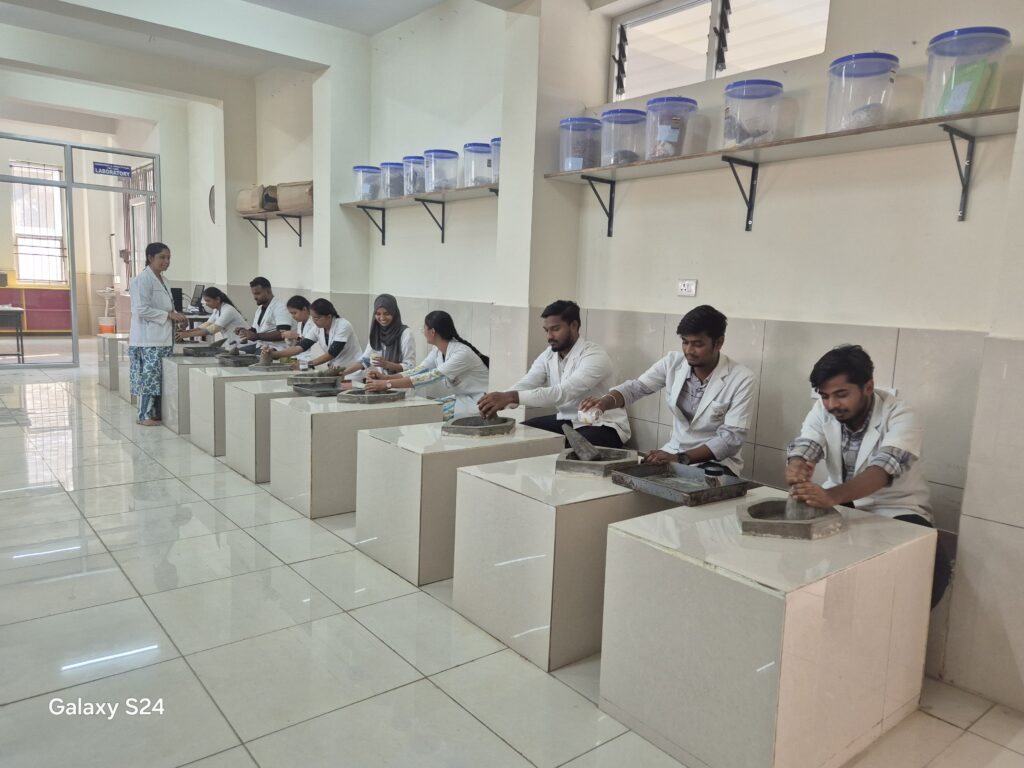
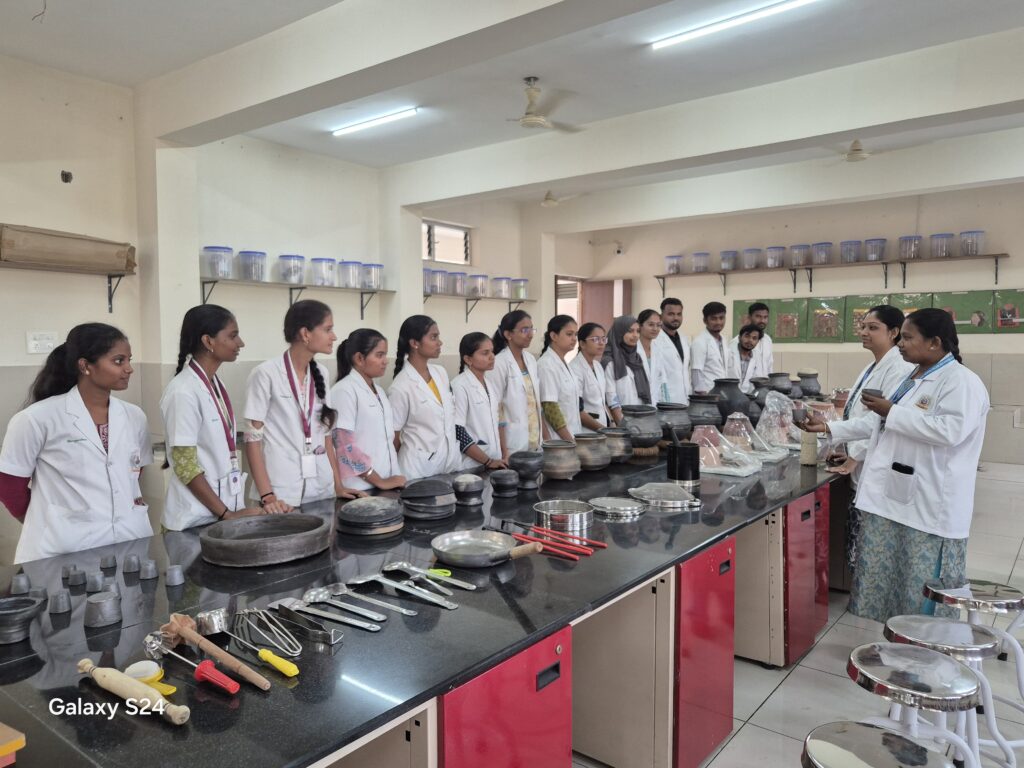
04 ) Department of Rasashastra & Bhaishajya Kalpana
INTRODUCTION: Our subject includes 2 different methods of preparation of medicine ie;
- Rasashastra- Rasa means Parad, and study about it in detail called shastra. In this subject we learn about Parad(Mercury) and other Minerals, Gems and Poisonous substances. which are clearly divided into groups. Each groups consist of 8-9 substance and each substance is well defined from its existence to its purification etc. From this all different minerals many medicinal formulations are prepared and explained properly and also preparation methods and Testing are explain in detail.
- Bhaisjyakalpana- bhaishya means Aushad. It deals with preparation of various compound/ formulation containing Herbal, Animal drug origin components through authentic standard procedure. Collectively all this final outcomes known as kalpanas.It is based on 5 basic kalpanas as well as on Upkalpana which are clearly discussed in this section.
VISION OF DEPARTMENT: Attain perfection in pharmaceutical processing of Ayurvedic formulations with Standard Operative Procedures.
MISSION OF DEPARTMENT: To develop standard quality dosage forms of Ayurveda formulations without altering the basic concepts to achieve utmost therapeutically benefits.
OBJECTIVES:
- To acquire Theoretical and practical knowledge of Kalpa at the end of Profession/course.
- To develop and modify classical formulations adopting advanced technology and to validate classical formulations to achieve safety and efficacy.
- To bring confluence in achieving academic excellence and promoting scientific Research methods in Rasashastra and Bhaishajya Kalpana.
TEACHING AND LEARNING METHODS USED BY DEPARTMENT: Teaching and learning process by the dept. is based on Student centric method. In which various techniques are used ie;
- Audio Visuals Aids
- Group discussion
- Tutorials
- Shloka recitation
- Demonstration
BENEFITS TO STUDENTS: Due to various activates conducted by dept. as well as using beneficial teaching methods students can get proper classical as well as modern knowledge about preparations of medicines

5) Department of Dravyaguna Vyaguna
- DRAVYAGUNARA VYAGUNA
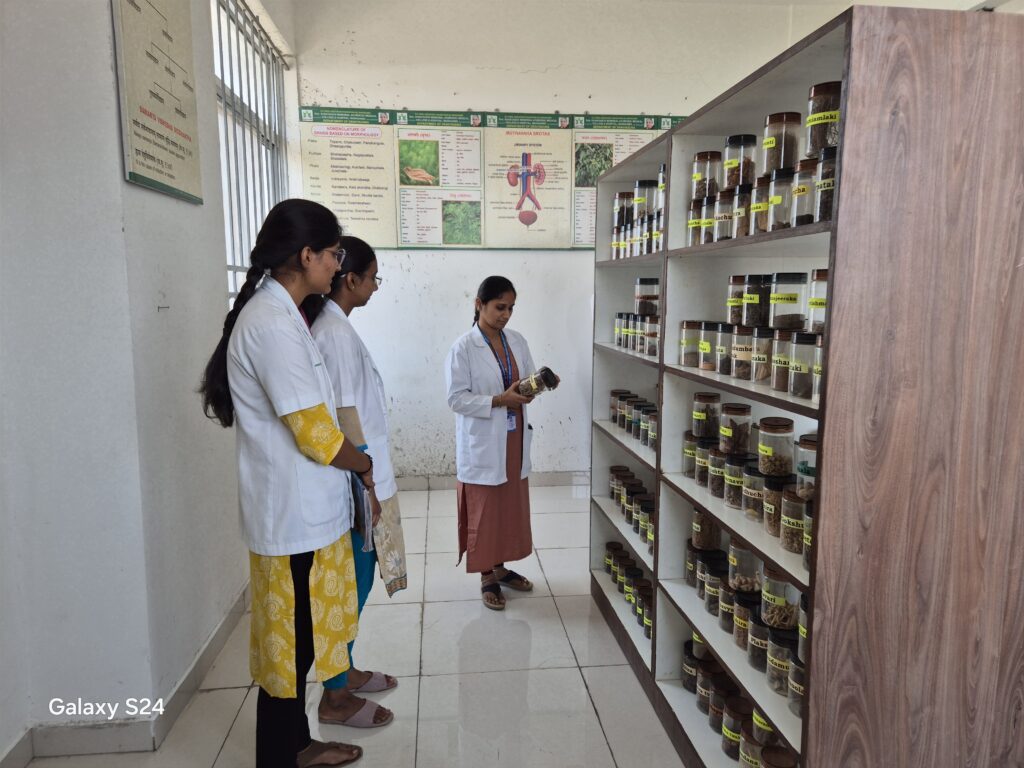
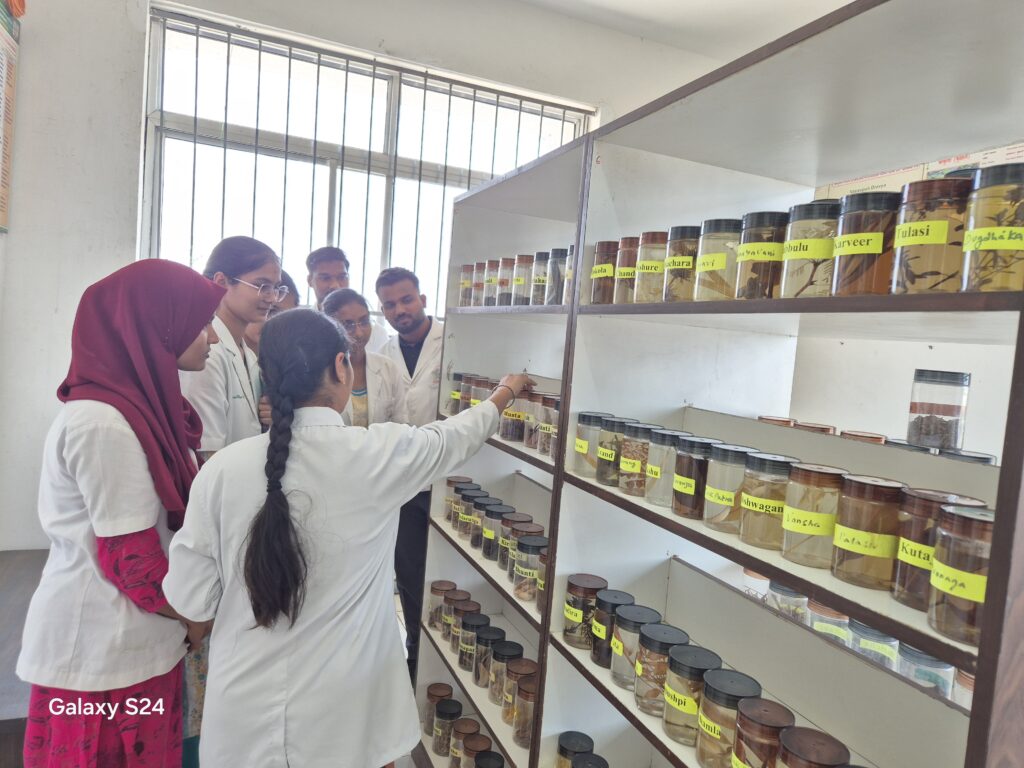
- INTRODUCTION:-Dravyaguna Vijnana is an integral part of Ayurveda, which deals comprehensively with dravya, rasa, guna virya, vipaka, karma, prabhava (pharmacokinetics and pharmacodynamics) of herbs, animal, and all-natural sources since are used from Vedic period. This Branch also deals with the identification, collection, storage, and preservation of raw materials of all earthy origins. This Department works with objectives to provide knowledge of fundamental principles of Dravyagunasastra, drug action as per Ayurveda, the Indian traditional system of medicine. It also aims to develop a research methodology for the understanding of principles of Ayurvedic Pharmacology & Materia Medica balancing Classical & Contemporary knowledge. The department focuses on the conservation and cultivation aspects of medicinal plants and also indulges the need of Health seekers by supplying household medicinal plants which serve as remedy common ailments.
- Vision:-Impart quality education and achieve academic excellence in Modern Pharmacology, Ayurvedic Pharmacology & Materia Medica principles, balancing Classical & traditional knowledge of Indian medicinal plants.
- Mission:-Upholding the principles of Dravyaguna and promoting the development of scientific temper for Ayurvedic Herbal Research and Nurture the young talents to become skilled professionals in pharmacodynamics and pharmacokinetics of Ayurvedic medicinal plants. Preserve endangered species of medicinal plants and herbs.
- Departmental Initiatives
- • A well maintained Two acres of HerbalGarden having 265 species, total 500 number of plants some important species are- Guggulu (Commiphora mukul), Pippali (Piper longum), Musli (Chlorophytum borivilianum), Kamal (Nuphar lutea), Vacha (Acorus calamus),
- • Well-maintained Terrace Garden of important medicinal plants and wish to develop Green House Nursery for cultivation of medicinal plant saplings and also caters to the need of Health seekers visiting our Institution and hospital by selling of medicinal plants at a nominal cost.
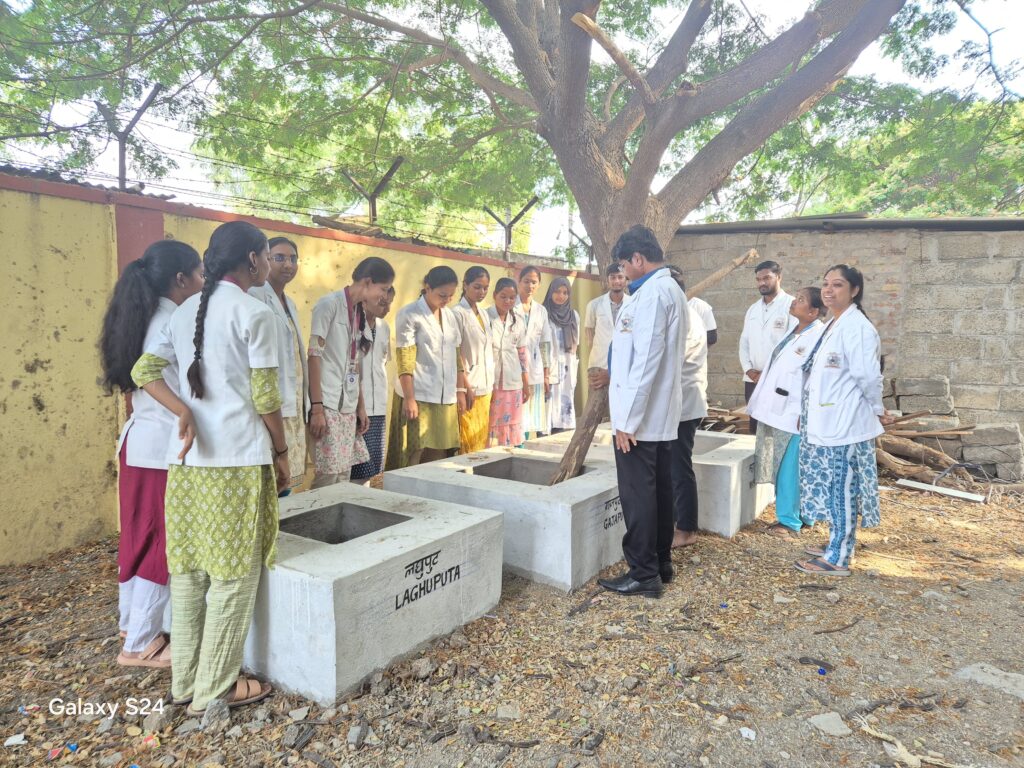
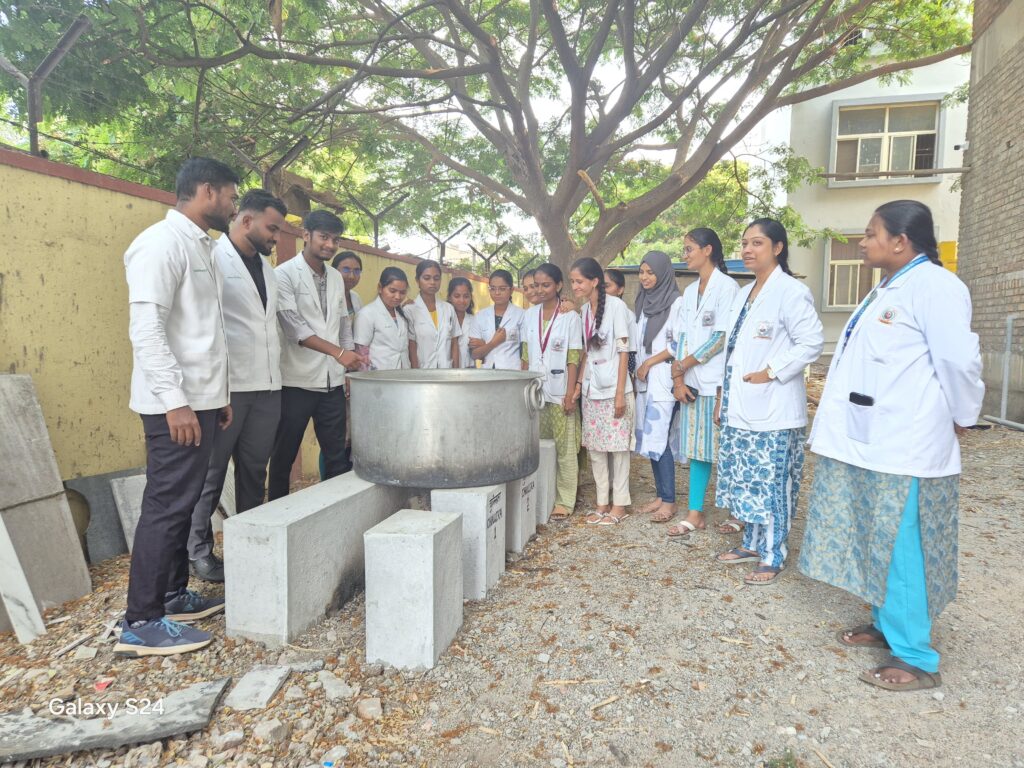
- • Dravyaguna Dept. timely organizes workshops and hands-on training in the field of Plant identification (Basic botany), herbarium preparation techniques, and seed ball workshops for conservation aspects.
- • The department frequently has activities like field visits to the nearby flora of western ghats, and also visit Mahatma Phule Krushi Vidyapeeth Rahuri and other parts of
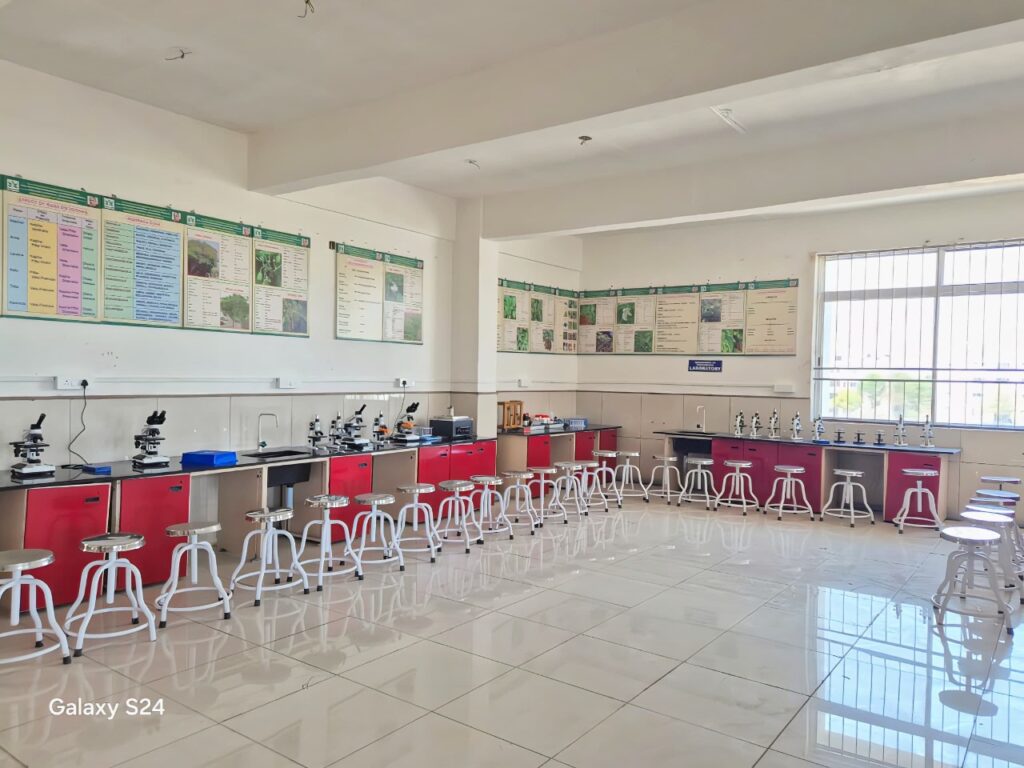
- • Besides market samples, drugs collected from the natural habitat of dry 366 and wet specimen 75 have been preserved. Plants preserved in formalin in their fresh state. The departmental library is enriched with 54 books on Dravyaguna, database, pharmacology, pharmacognosy & Samhita, etc.
- • The herbarium includes 50 families.
- • Plants are labelled QR codes that are identified by botanists.
- • Mode of education students received by lectures, PowerPoint templates, demonstrations, field visits, herbal garden visits, and pharmaceutical company visit to get basic standardization methods of natural products, identification of adulterants and substitutes, pharmacovigilance and adverse drug effects.
- • Department encourages Research aspect in students by guiding them in oral paper presentations and Publications in peer review International Journal.
- DEPARTMENTAL ACTIVITIES
- Department encourages Research aspect in students by guiding them in oral paper presentations and Publications in peer review International Journal.


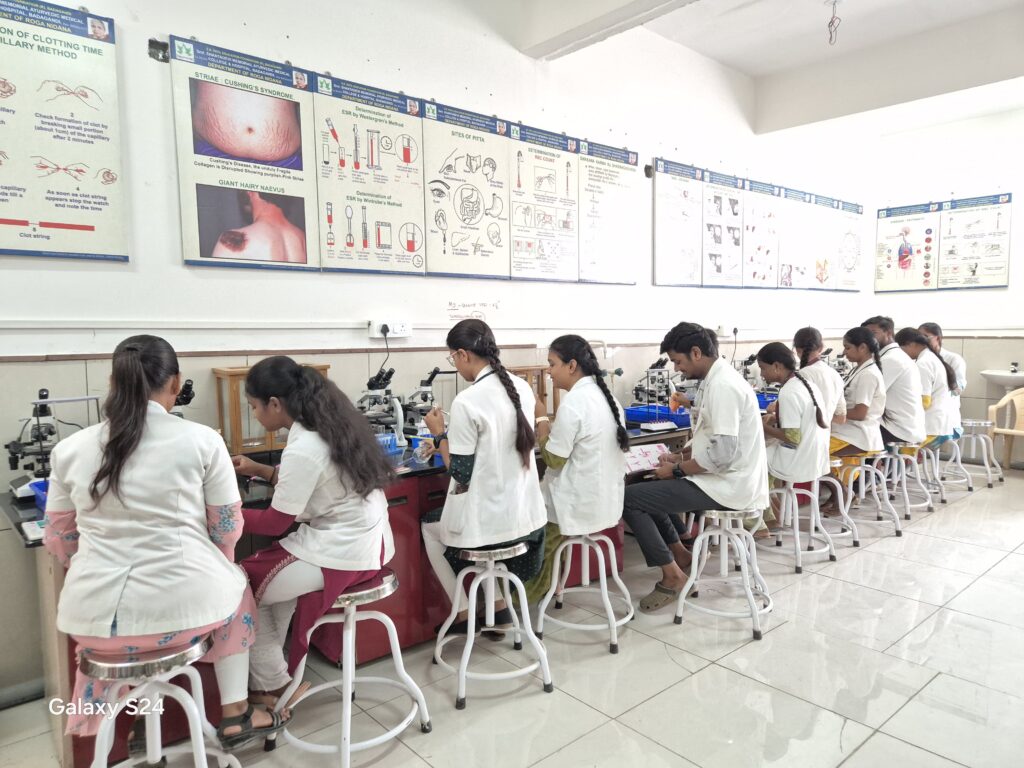
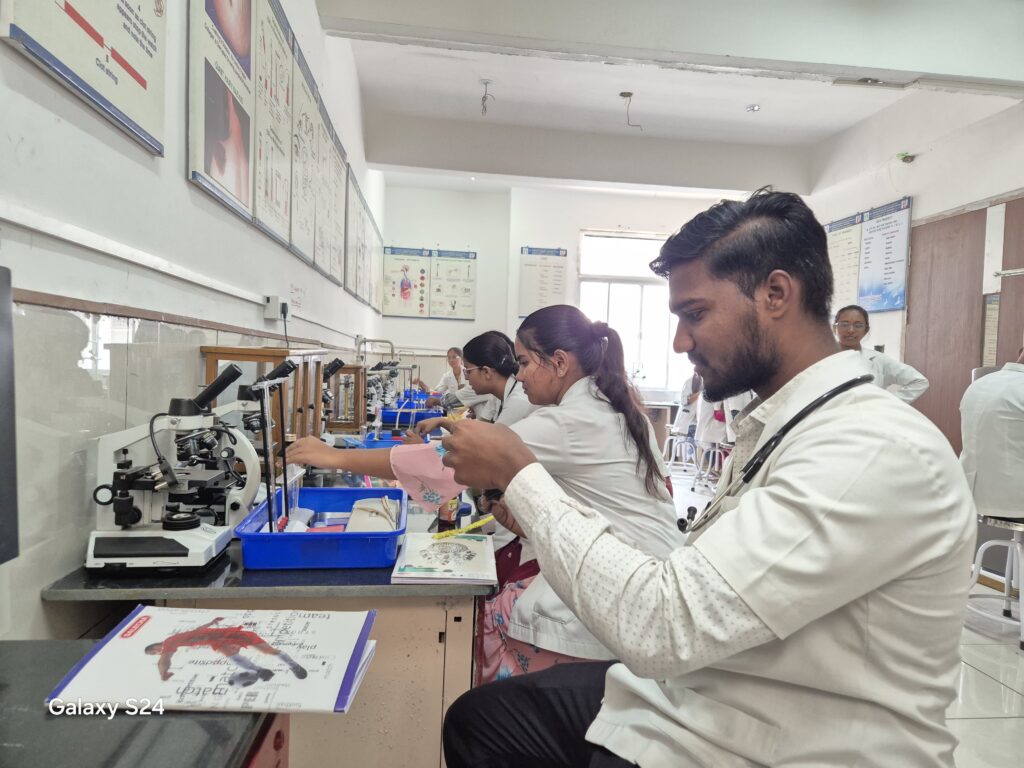
06) Department of Roga Nidan evam Vikriti Vigyan
ROGNIDANA AVUM VIKRITI VIGYANA
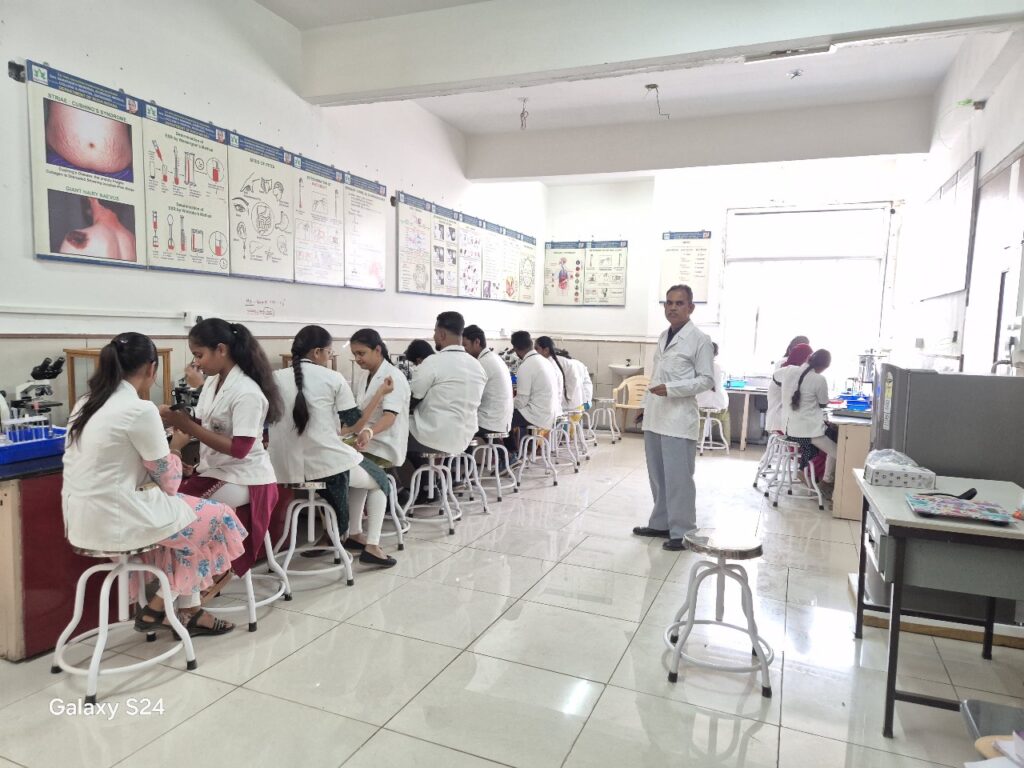
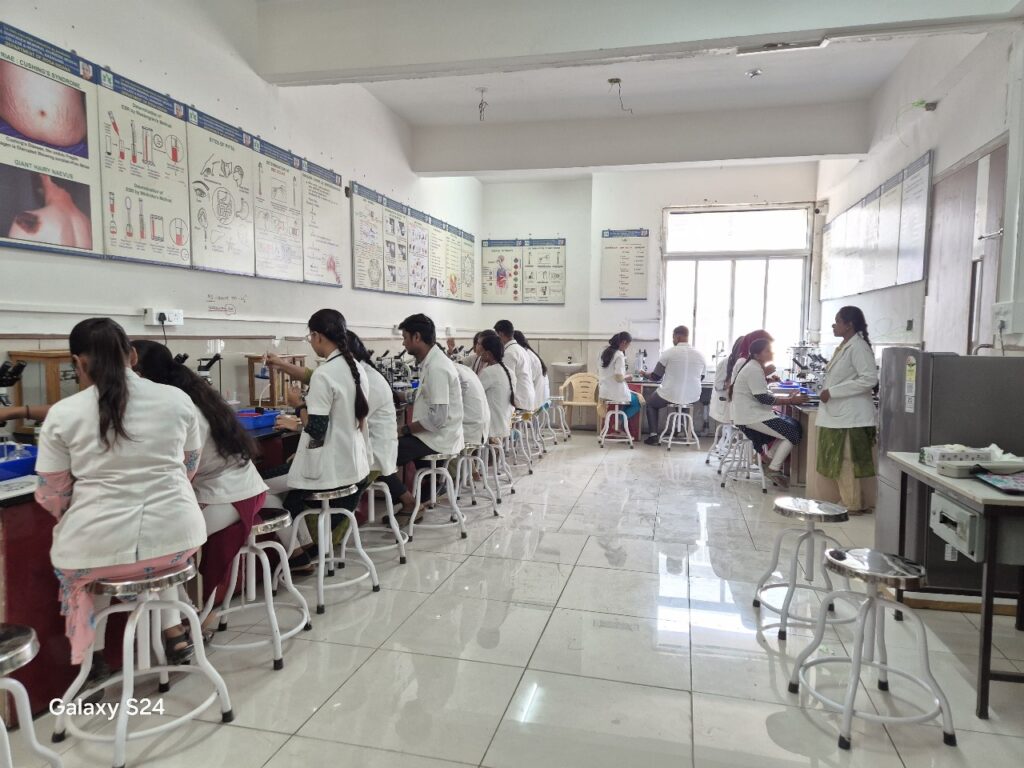
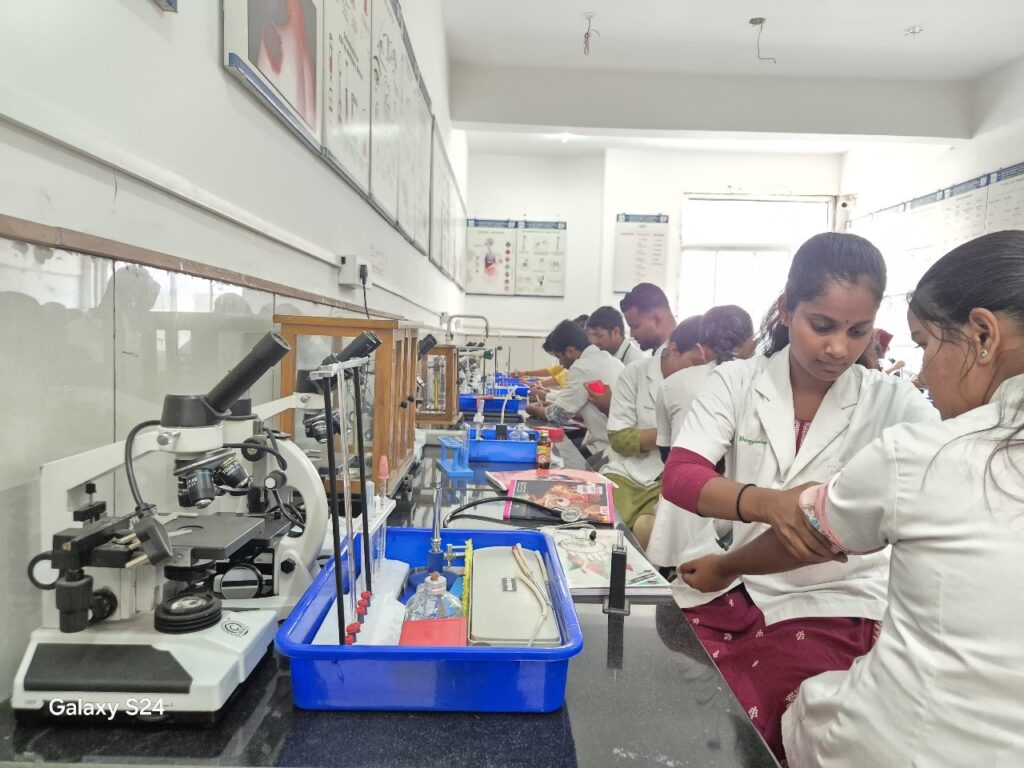
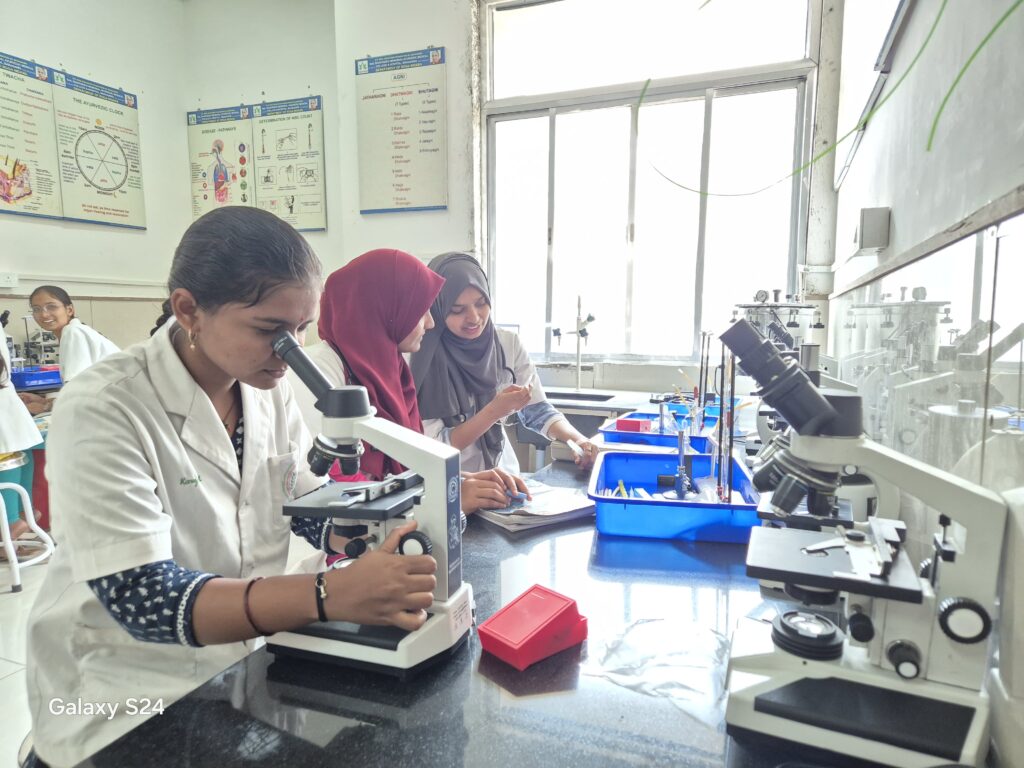
Introduction: In this Rognidana Dept we study about the causes of the disease, changes in their normal functions, deformity in the organs while disease has been caused. There are various kinds of examinations like Trividha Pariksha, Chaturvidha Pariksha, Shadvidha Pariksha, Ashtavidha Pariksha, Dashavidha Pariksha helps us to know whether the person is (Swastha) normal or (Aswastha) abnormal.
Shatkriyakala means how diseases are manifested stage by stage in the body. Strotas Sankalpana , Vyadhi Awashta, Diseases study by Nidan Panchaka like nidana, poorva roopa, roopa, upashayanupashaya and samprapti.
Vision Of Department : Rognidana Dept teaches students to examine the patient and to diagnose disease by various kinds of examinations mentioned in the granthas. At which stage of the disease, is disease curable or not. Sadyasadyata we can conclude through Arishta Lakshanas.
Mission Of Department : To diagnose the patient’s disease at the early stage and to give the proper treatment which is needed. Nidan panchak , Nidan Parivarjana, Pathya and Apathya Ahara are advised to patients to cure the diseases.
Objectives :
1. Examination of patient
2. Examination of Rugna Bala , Rog Bala
3. Is disease curable or not assessed through the condition of patient “Arishta Lakshnas”
4. Chikitsa Chatushpad
5. Strotas Sankalpana Study
Teaching And Learning Methods :
• Class room teaching through theory lectures.
• Batchwise practical classes.
• Group Discussion.
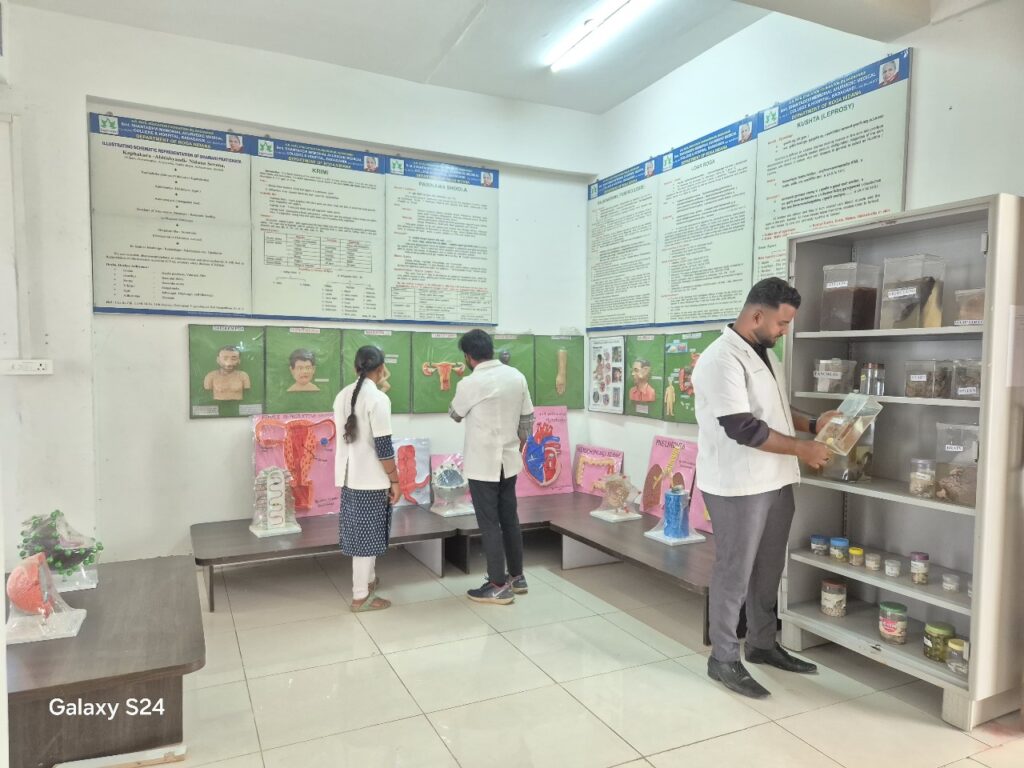
• Project \ Models Making according to the disease pathology.
Benefits to Students:- Students learn more effectively by the above mentioned methods. Definitely students will utilize all these methods while they examine the patients by this they become good well trained doctors.
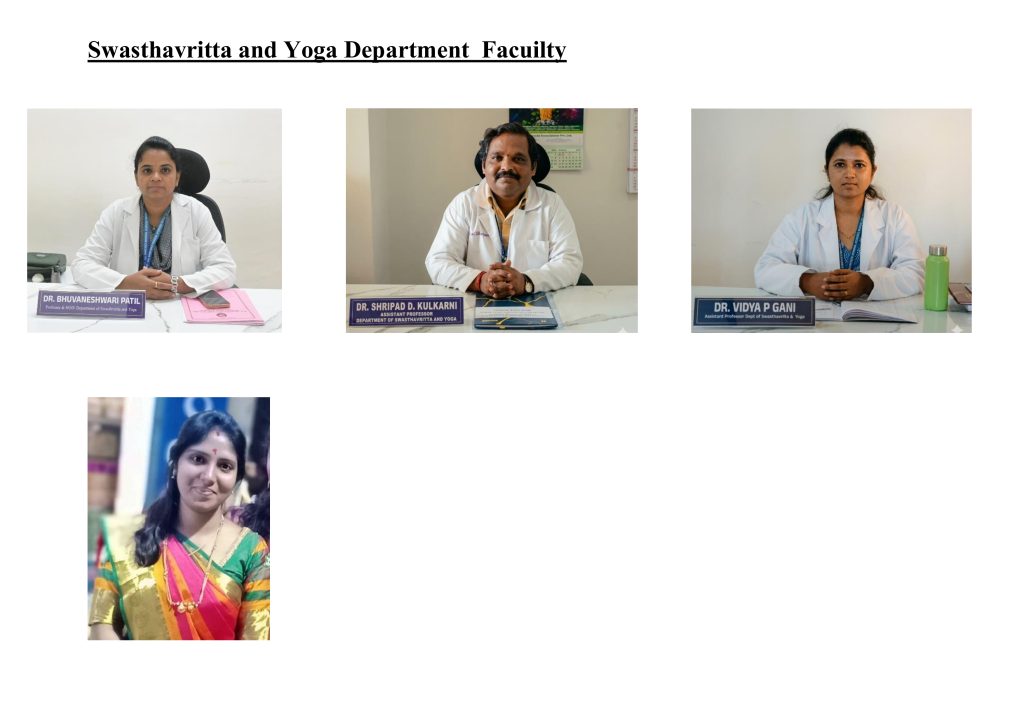
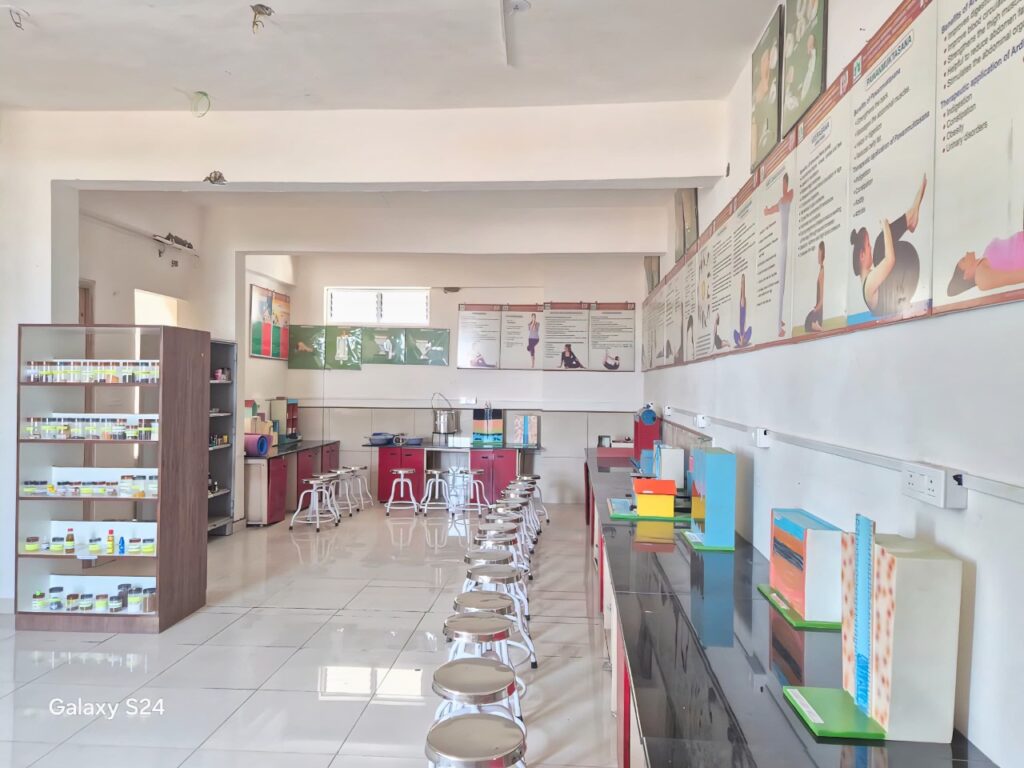
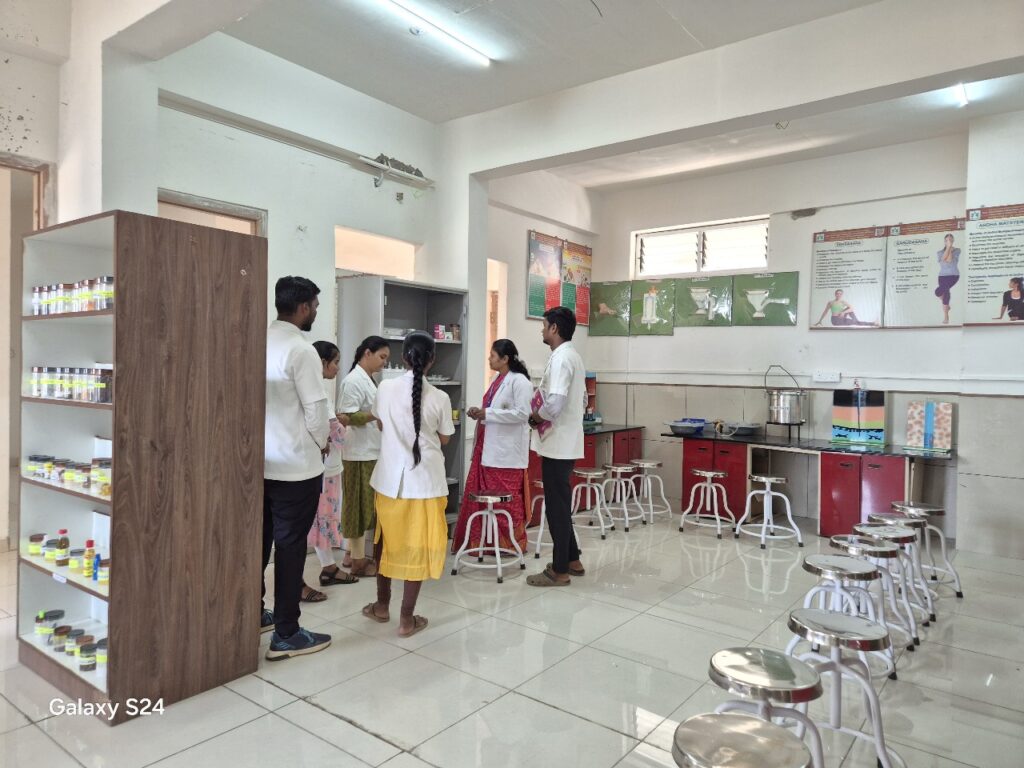
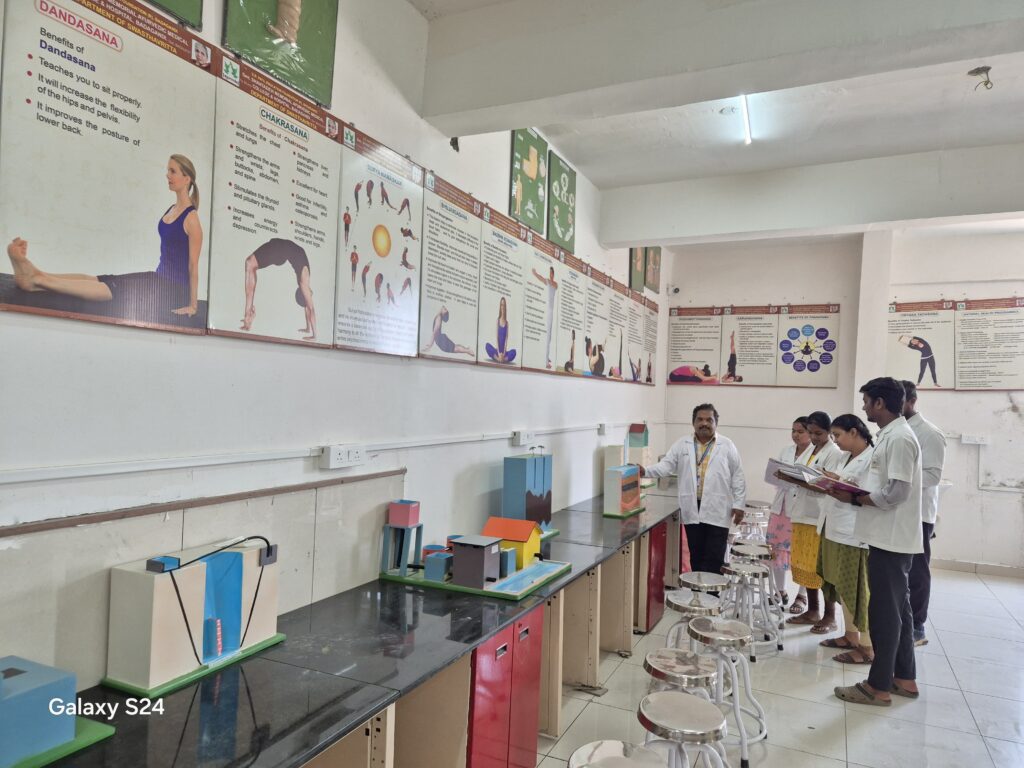
07 ) Department of in Swsasthavritta and Yoga
The Swasthavritta and Yoga department focuses on preventive healthcare, lifestyle management, and holistic well-being based on Ayurvedic principles and yogic sciences.
Vision
To promote holistic health and well-being by integrating the principles of Swasthavritta (Preventive Medicine) and Yoga, fostering a disease-free society through a balanced lifestyle, diet, and mental well-being.
Mission
1. Preventive Healthcare Awareness – Educate individuals on Ayurveda’s preventive measures, including Dinacharya (daily regimen), Ritucharya (seasonal regimen), and Sadvritta (ethical conduct) to maintain health.
2. Promotion of Yoga & Ayurveda – Encourage the adoption of Yoga, Pranayama, and Meditation for physical, mental, and spiritual well-being.
3. Community Health Initiatives – Implement public health programs, workshops, and research to address lifestyle disorders like diabetes, hypertension, and obesity.
4. Evidence-Based Research – Conduct scientific studies on the efficacy of Swasthavritta and Yoga in preventing and managing diseases.
5. Holistic Education – Train healthcare professionals with a deep understanding of Ayurveda, Naturopathy, and Yoga, integrating traditional wisdom with modern scientific approaches.
6. Environmental Health & Sustainability – Promote eco-friendly practices, including Ayurvedic dietetics, detoxification therapies, and natural living, for overall societal well-being.
08 ) Department of Agada Tantra Evum Vidhi Vaidyaka
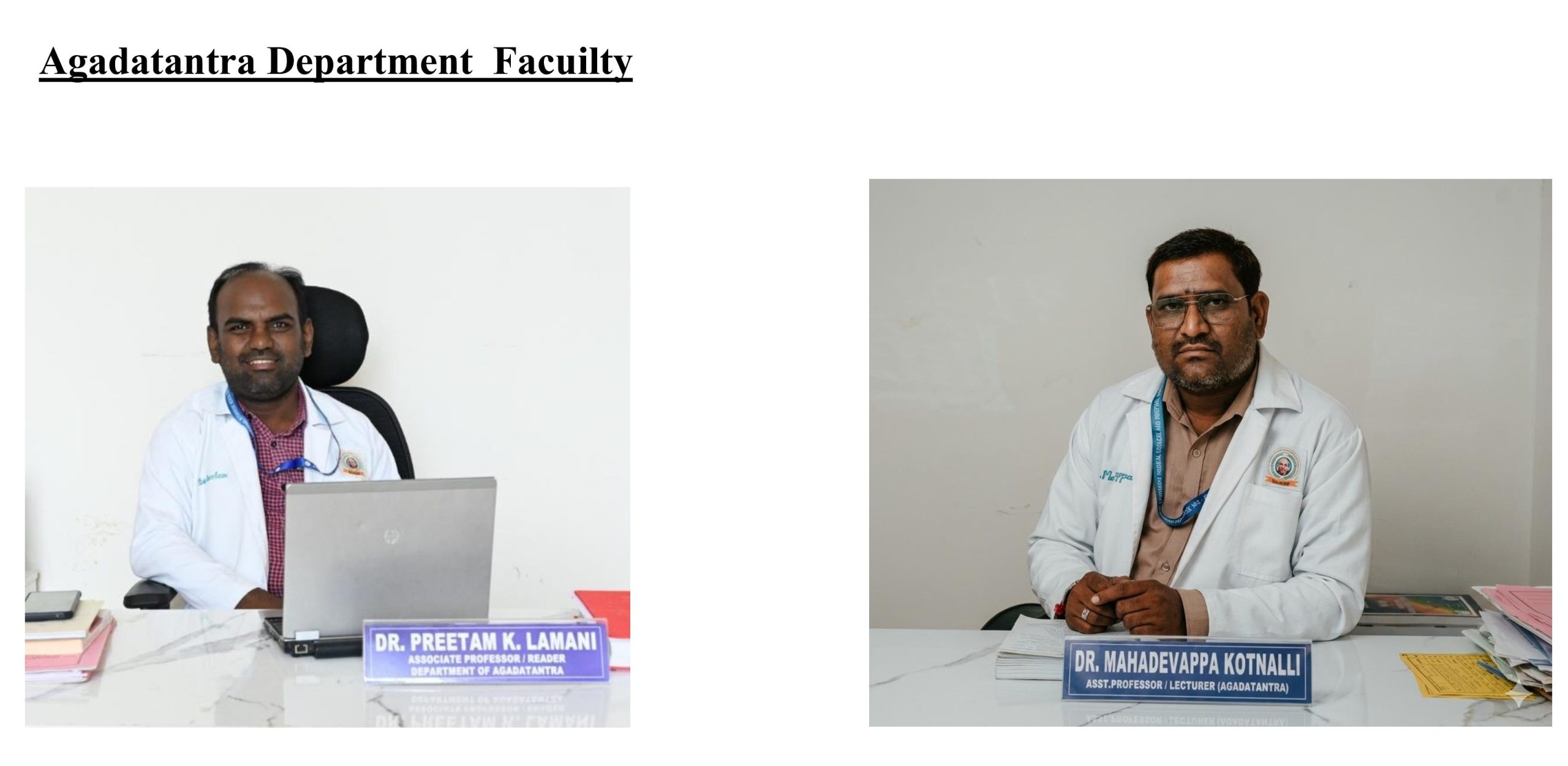
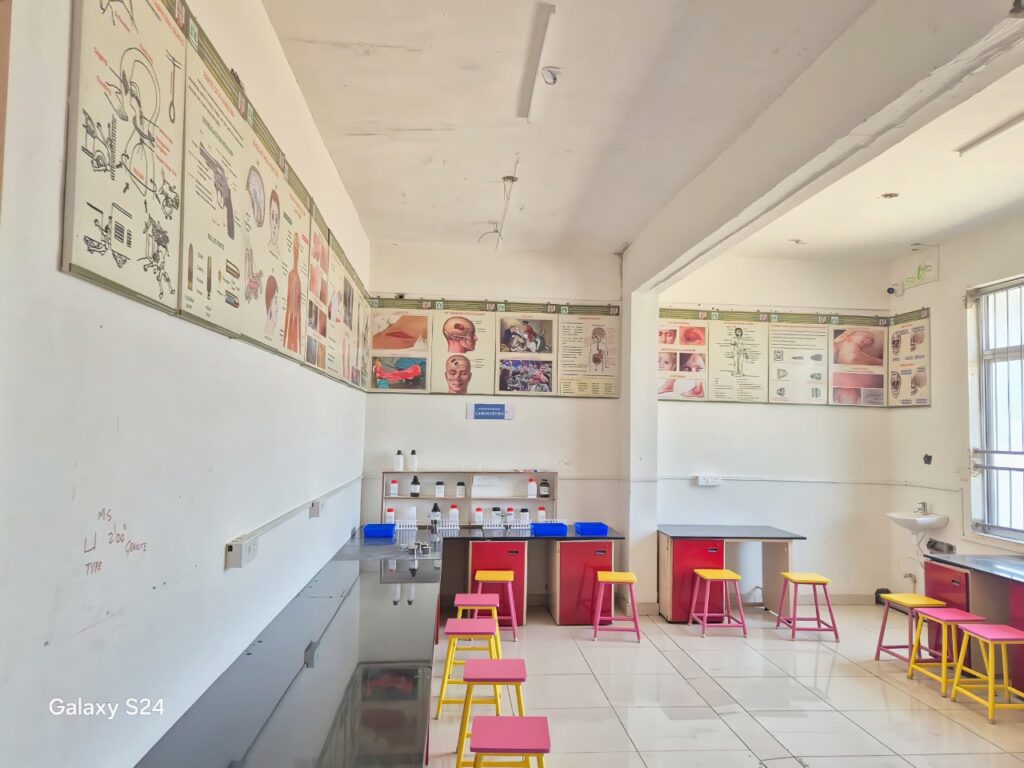
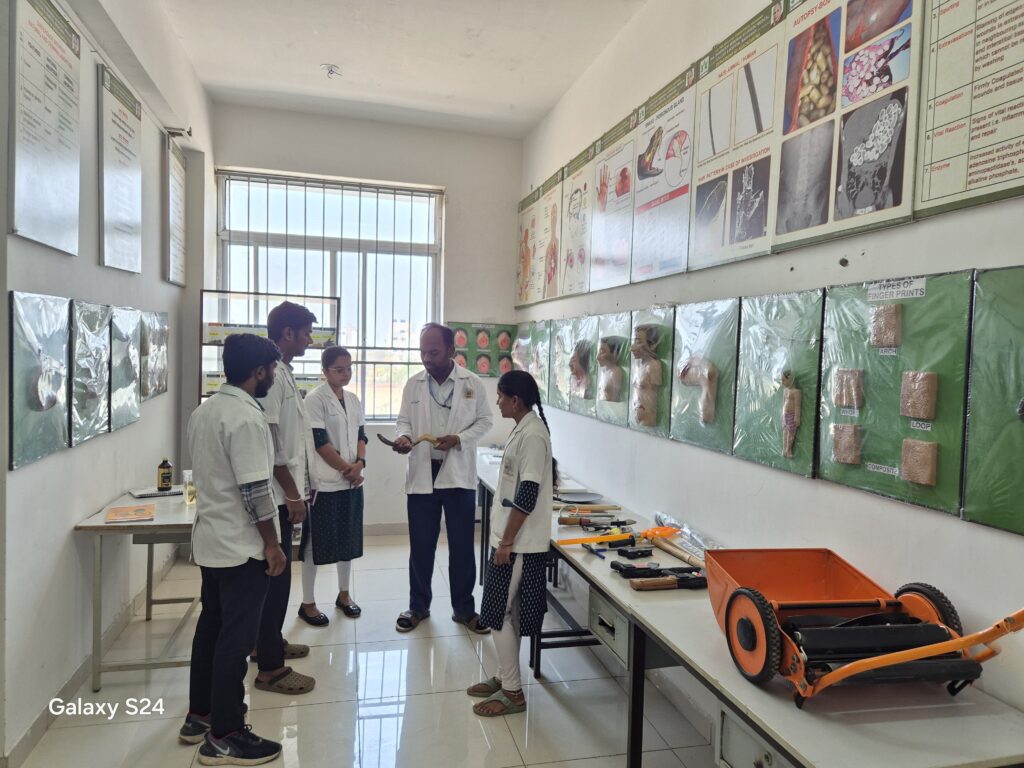
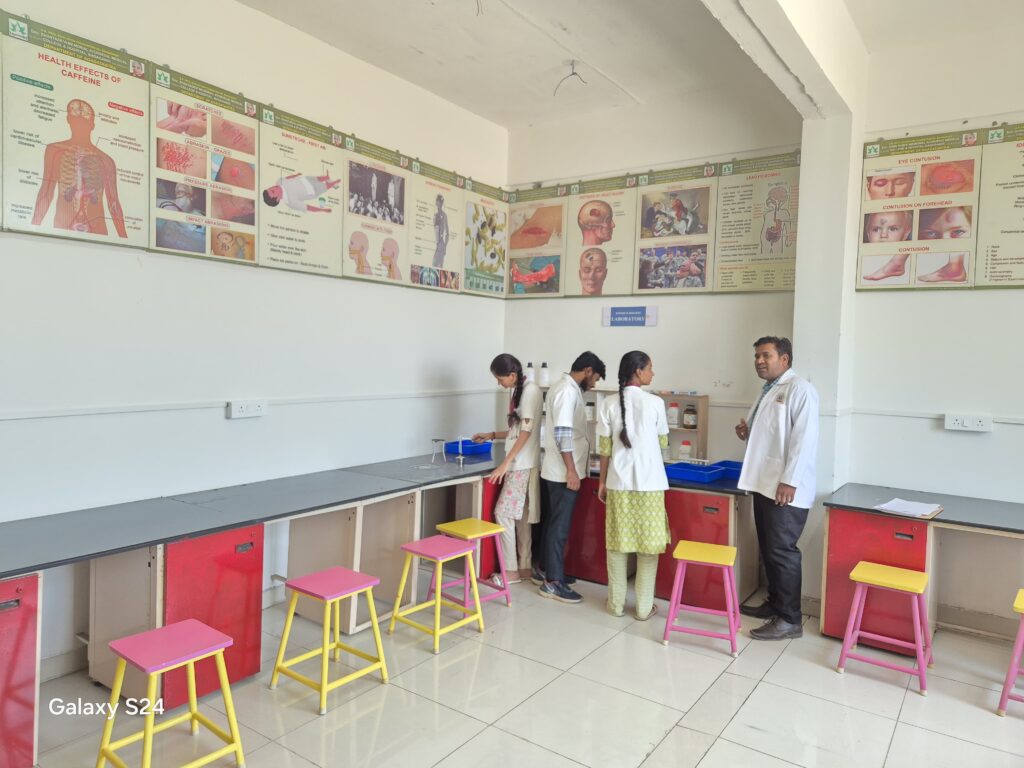
Agada Tantra is a branch of Ayurveda which deals with identification, prevention, diagnosis and treatment of various Visha conditions (Animate, Inanimate, Subclinical, and Residual and Cumulative toxicological presentation). the department is growing and working for the upliftment of Agada Tantra.
To uplift the glory of Ayurveda Vishachikithsa by exploring the classical and traditional knowledge on scientific grounds.
Mission
Explore the VishaChikithsa by adapting and using Current Scientific Technologies with collaboration to Centre’s of Excellence and Traditional Practitioner’s.
Objectives:
To scientifically validate the Antidoatal effects of Agada ‘s, for Garavisha (artificial Poisons) and Dooshivisha (Low potent poisons)
To survey the traditional Practices of Visha Chikithsa.
To establish the art of treatment of Skin Diseases Through fundamentals principles of AgadaTantra.
To Establish the Ayurveda Environmental Toxicology on Scientific grounds.
Department works in domains like organ toxicities caused by routine food and medicines, Teratogenecity, Antidotal activity, Environmental toxicity, residual and cumulative toxicity etc.
Department has come up with innovative practices like adulteration tests, weekly presentation of Medico-legal cases and many other which are required for present scenario where even consuming food & water is not considered safe.
Department also engages itself to different visits to Snake Park, Forensic Science Laboratories, State Pollution Control Board, Court visits, Industries, Folklore Practitioners, Surveys, Food Adulteration Testing Centres and many more. These visits help the students to update and understand the importance of Agada Tantra in relevance to modern health and lifestyle. With this knowledge the Students are encouraged for practice of Agada Tantra with concepts of Garavisha, Dooshivisha and able create awareness of increasing trends of chemical bio magnification in food chain and ecosystem.
3rd Year Professional Departments
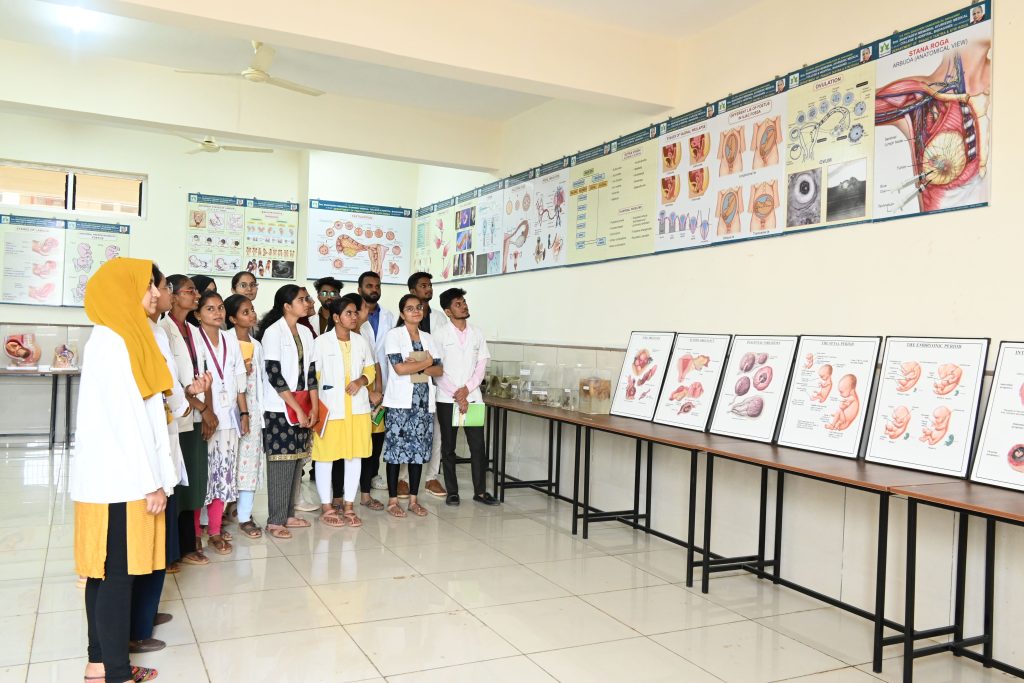
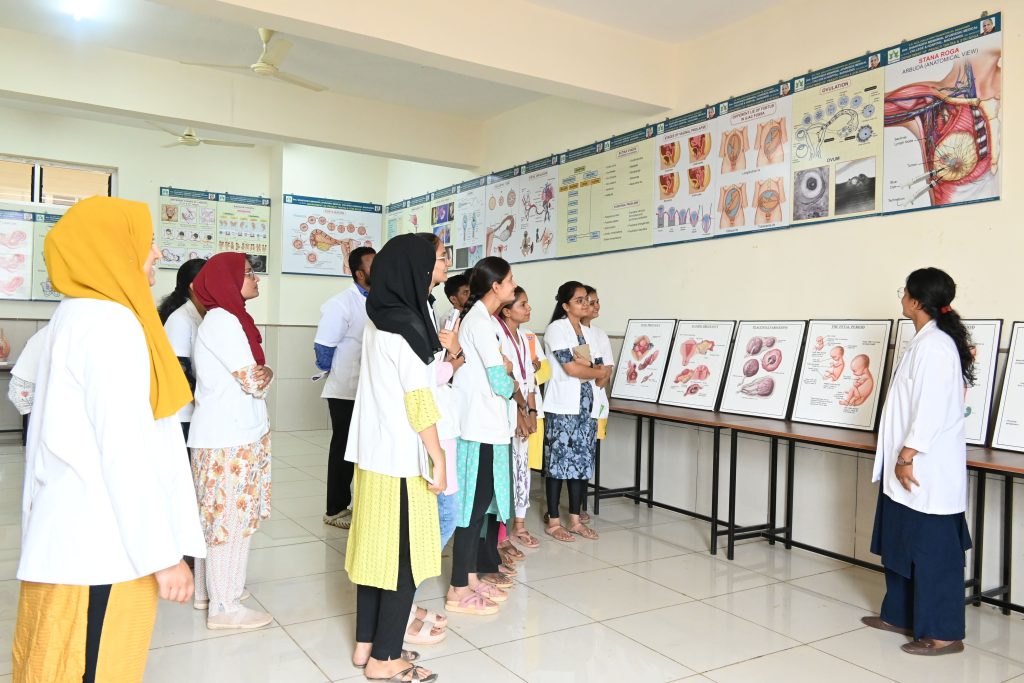
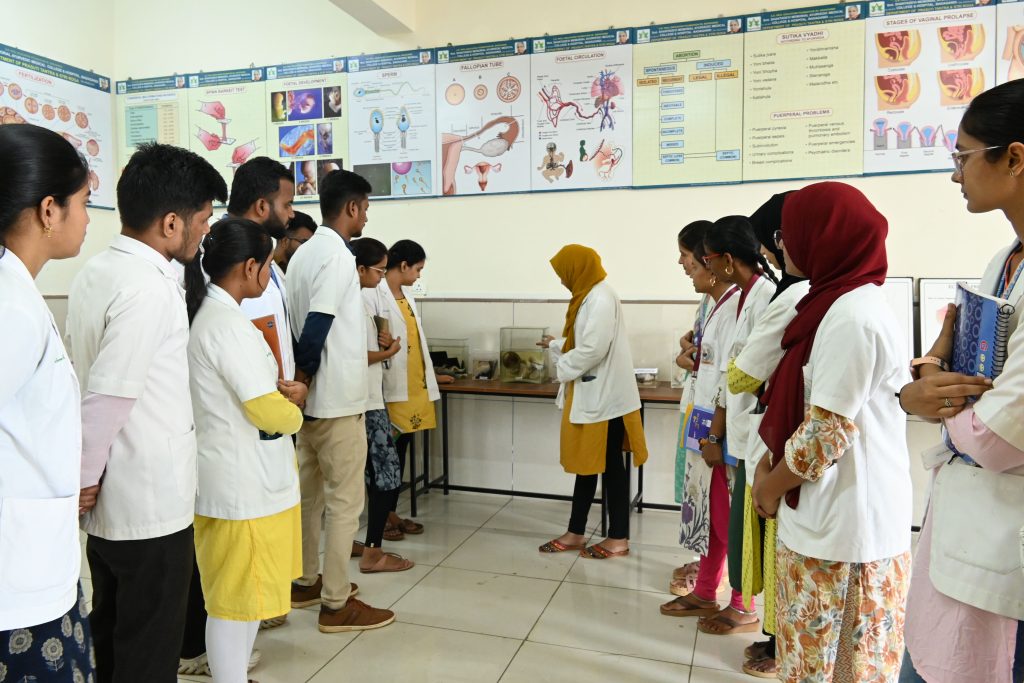
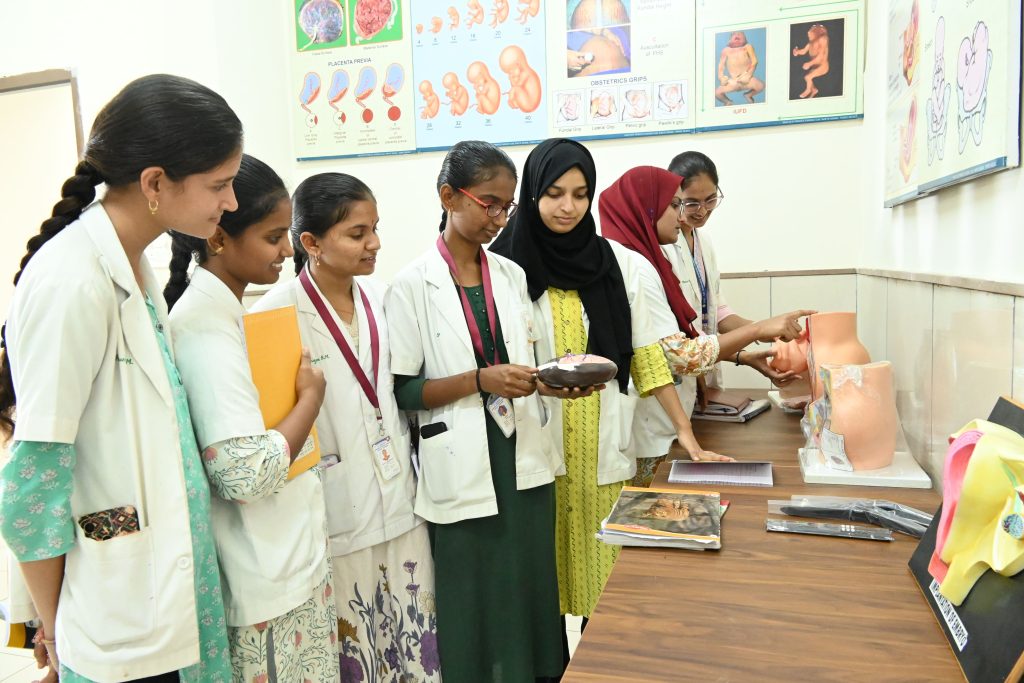
09 Department of Prasooti Tantra and Stree Roga
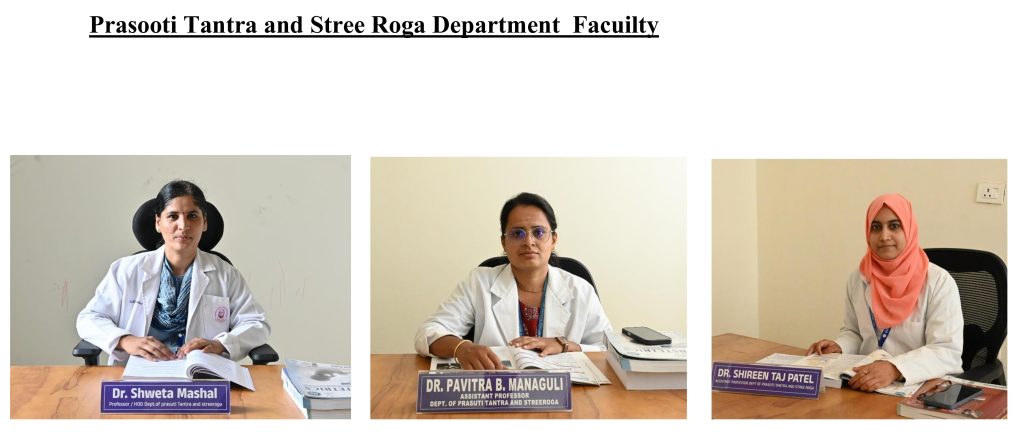
Department of Prasooti tantra and stree roga focuses on a compelte care of a women from menarche to menopause and beyond. It not only advocates treatment for various disorders in women but also suggests various regimens at each important transitional phases like Ruthumathicharya during the menstrual phase, garbhasamskara to achive healthy pregnancy garbhiniparicharyas during pregnancy, soothika paricharya after delivery.It emphesis the importantance of women’s health as she is the person who is responsible for the next generation.
Vision
- To empower each and every students in various ayurvedic concepts in the field of prasootitantra and stree roga and to excel in this field.
- To provide the best doctors to the society who are confident of handling any kind of problems related to prasooti tantra and stree roga
Mission
The department’s mission is to establish a Center of Excellence by training the next generation such that
- They have a scientific understanding of various paricharyas so that they can propagate the same in the society.
- To provide adequate practical knowledge so as to handle each and every case with lot of confidence.
- To take up research projects in the field of prasooti tantra and stree roga
- To provide an environment for the all round development of the student in the field of Prasooti and Stree roga
Departmental Initiatives
- To educate the importance of pre conceptional care in order to obtain a healthy child devoid of various genetic congenital and neurogenic disorders.
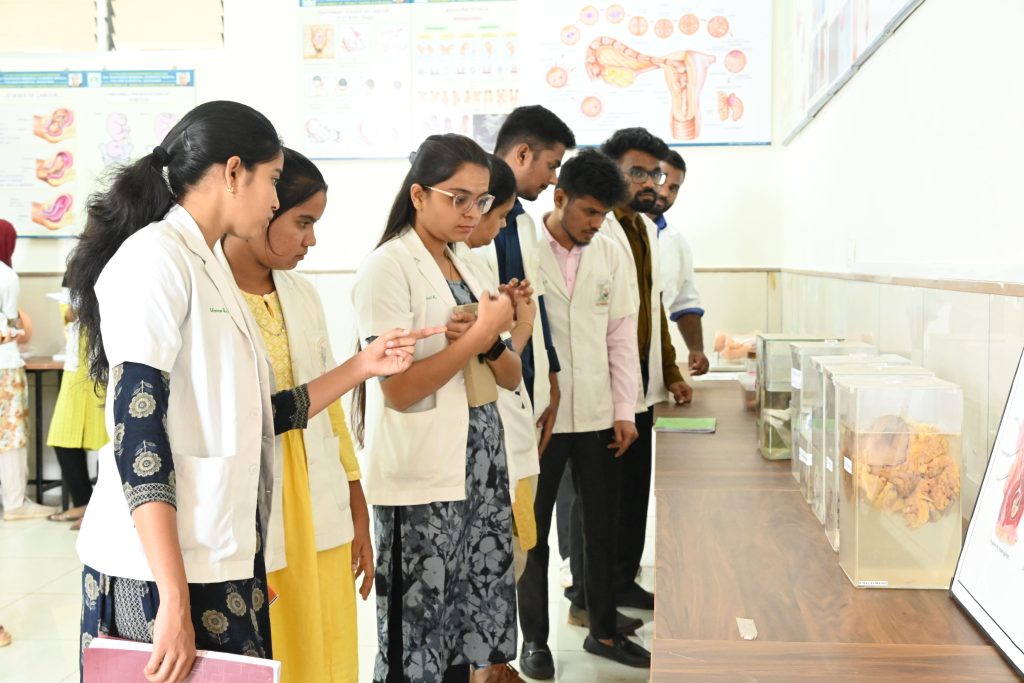
- To provide practical exposure to each and every students in all types of sthanika chikitsa
- Create awareness about the various screening methods in women
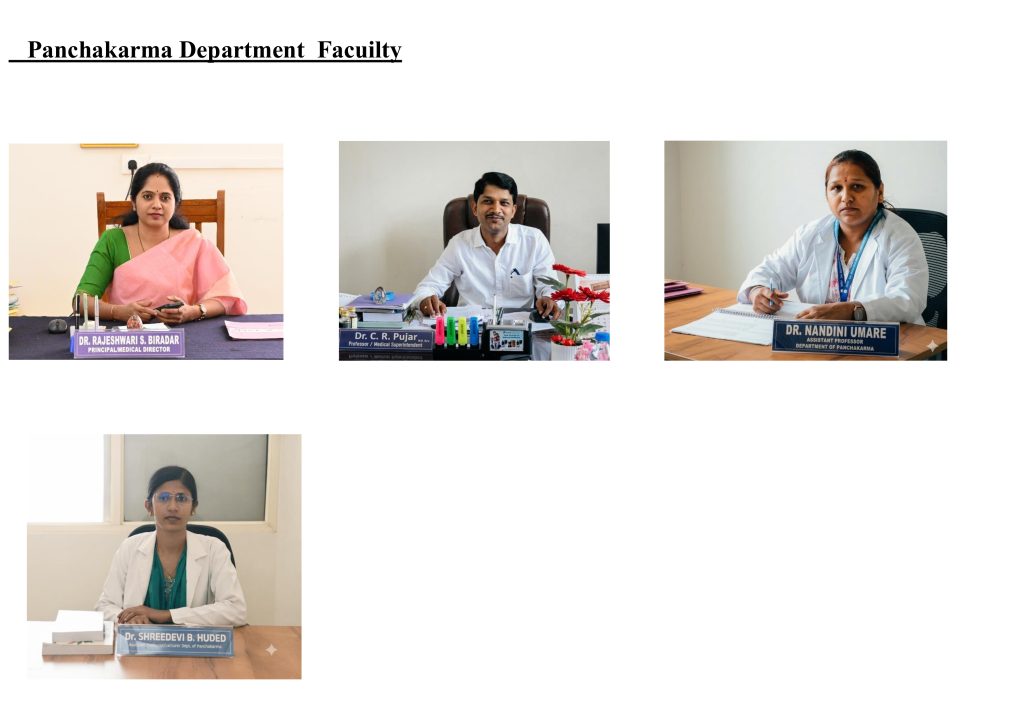
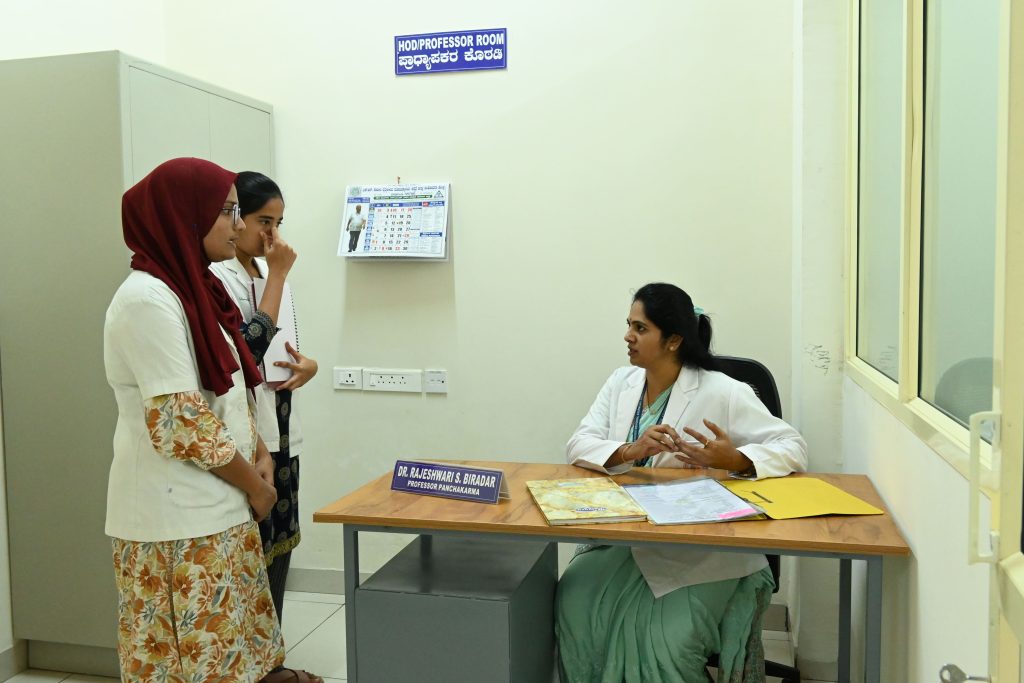
10 ) Department of Panchakarma
Panchakarma department is a clinical department established to promote quality education to the students, with the motto of ”swasthasya swasthya rakshanam aturasya vikara prashanam “.
Panchakarma is the super speciality department of Ayurveda which deals with the treatment modalities like Vamana(therapeutically induced emesis), Virechana(therapeutically induced purgation), Basti( therapeutically induced enema – oil and decoction based), Nasya(therapeutic nasal drops), and Raktamokshana(therapeutic blood letting) and all types of Bahyasnehana( external oleation therapies), Swedana procedures( therapeutic sudation procedures) meant for deep and complete cleansing of the system to bring back equilibrium of deranged biohumors.
Our department is focussing to provide classical knowledge regarding Panchakarma and its utility for various ailments from Paediatrics to Geriatrics specially emphasisng on Orthopaedic,rheumatology, Neurology, pulmonary and other disorders.
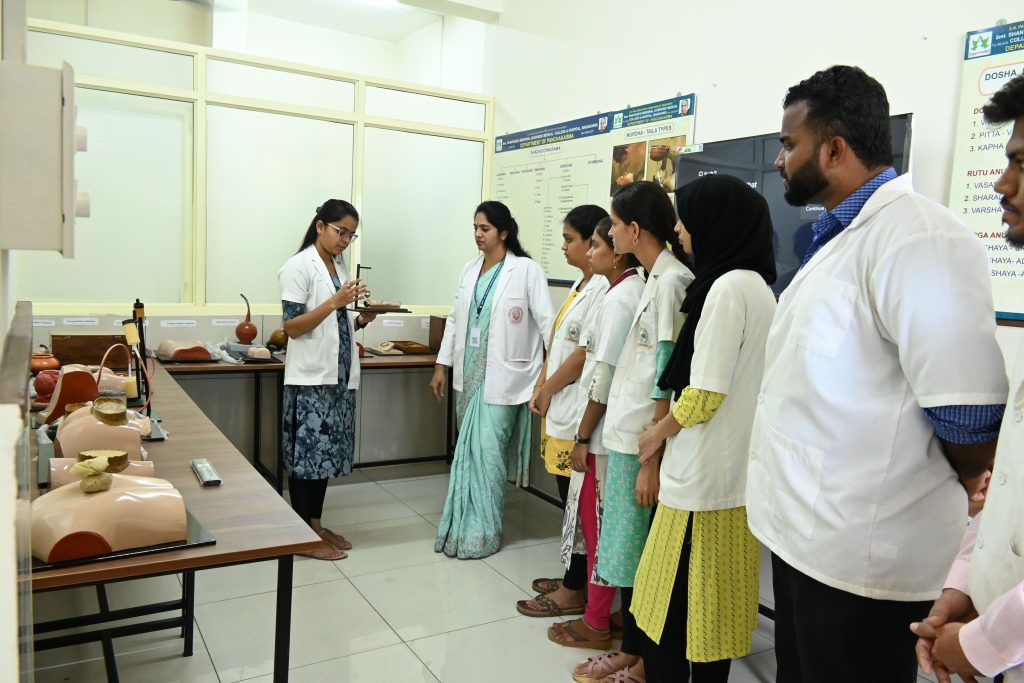
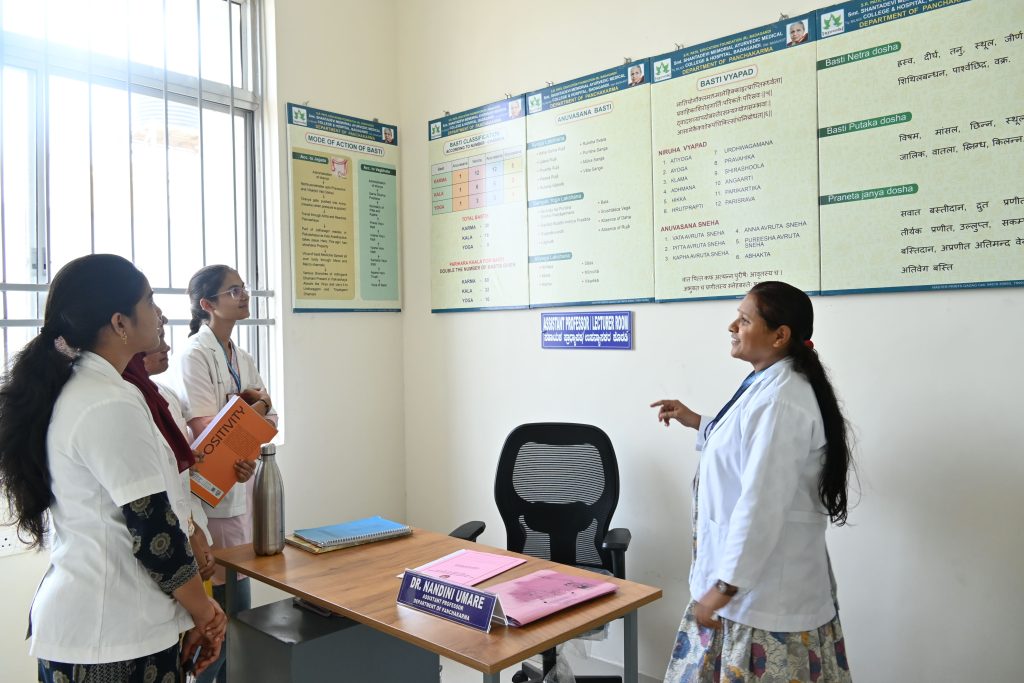
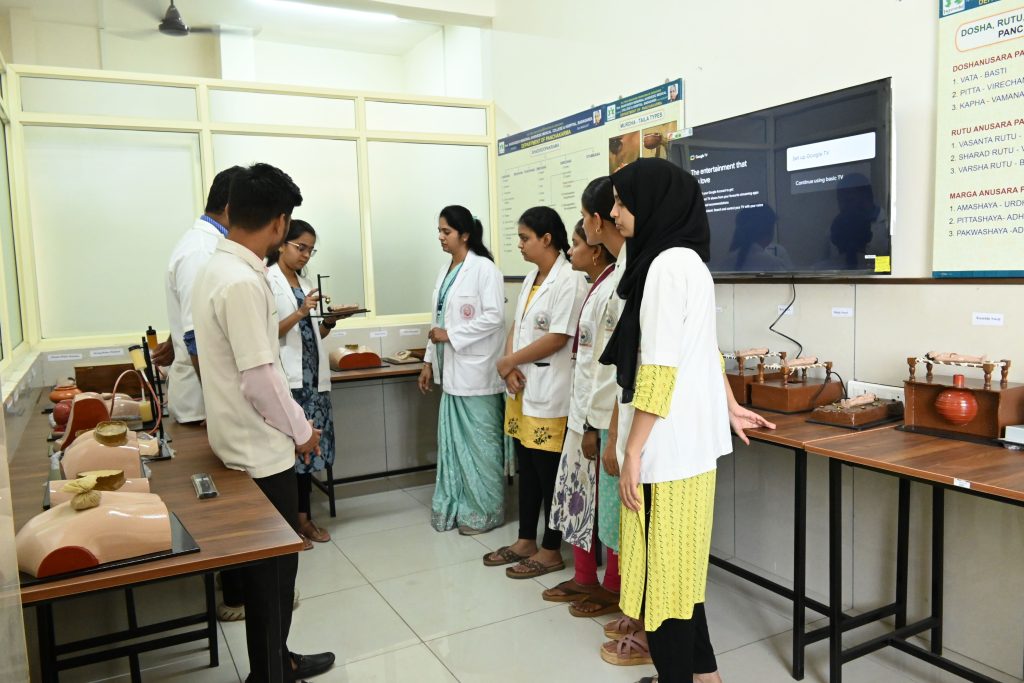
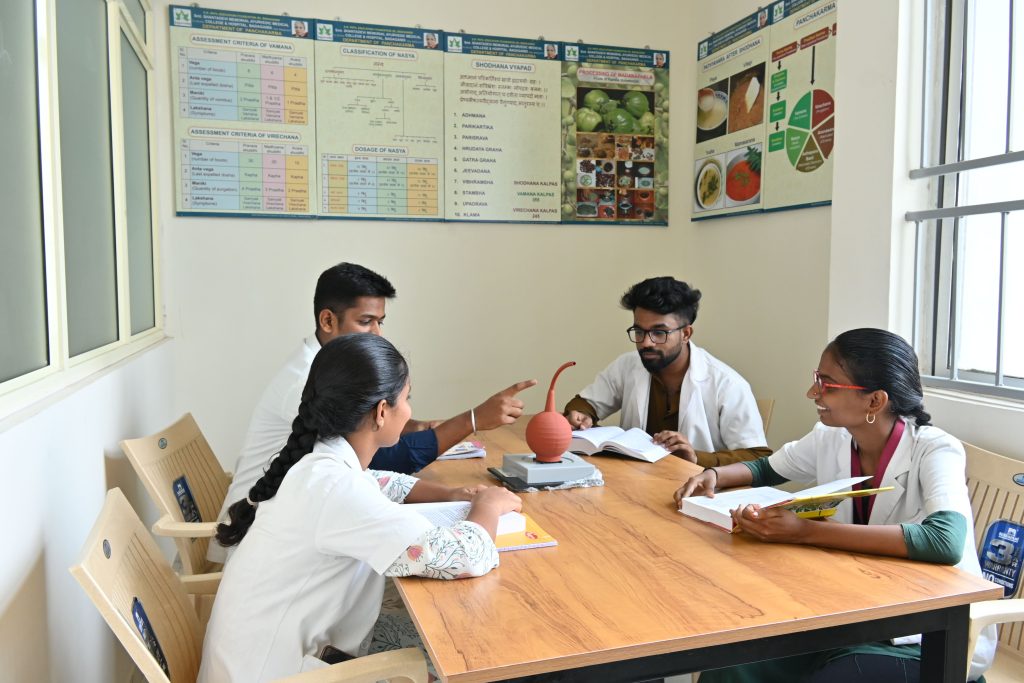
The academic facility of our department has various panchakarma procedure models, specimens, informative charts in display and departmental reference library lodges more than 80 books.
Vision
- ”swasthasya swasthya rakshanam aturasya vikara prashanam “
- “Enter to learn indian medicine and exit to serve the needy to create healthy society”
- To restore and rejuvenate the health and to manage and cure the diseases from paediatric to geriatric conditions by adopting suitable validated panchakarma procedures.
- To create awareness in the society and to educate students regarding the importance and uniqueness of panchakarma therapies.
- To uplift and uphold the role and importance of panchakarma in other specialities of Ayurveda
Mission
- To impart classical method of treatments and providing more authenticated, scientific measures with traditional touch.
- To prepare skilled, dedicated, passionate Panchakarma Specialists to the society and to provide quality service in every possible place and means.
- To take up the research activities for in-depth analysis and applications of the Principles of the Panchakarma.
Departmental Initiatives
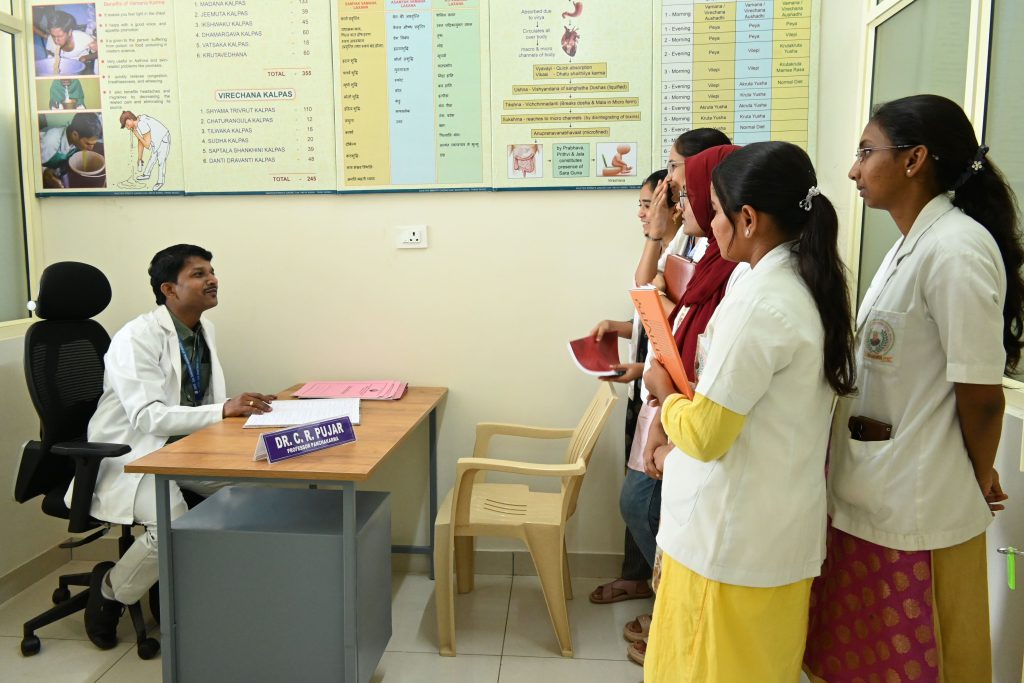
To provide exclusive and extensive Hands on Training to the students to make them aware of the practical approach, differentiate between theory and practical aspect and to observe changes on daily basis.
The practical exposure to the students given with respect to OPD, Panchakarma Procedures, preparation of Panchakarma Yogas and observation of IPD patients to analyse the efficacy of Panchakarma treatment and to Educate and encourage the students and the public to undergo Rutu Shodhana for healthy society.
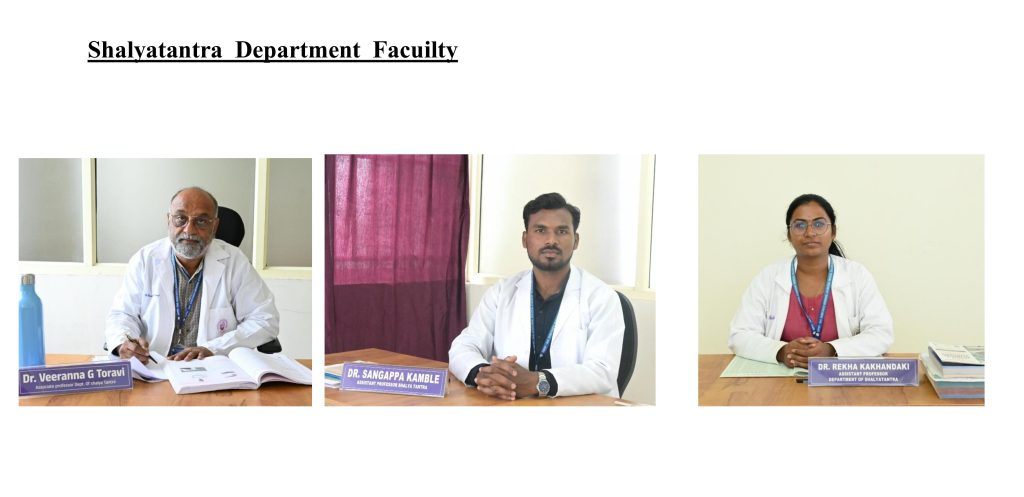
11 ) Department of Shalya Tantra
To provide exclusive and extensive Hands on Training to the students to make them aware of the practical approach, differentiate between theory and practical aspect and to observe changes on daily basis.
The practical exposure to the students given with respect to OPD, Panchakarma Procedures, preparation of Panchakarma Yogas and observation of IPD patients to analyse the efficacy of Panchakarma treatment and to Educate and encourage the students and the public to undergo Rutu Shodhana for healthy society.
Vision
We are committed to provide the quality education and skilled training to students of next surgical generation
Mission
- We strive to deliver best to every patient every day
- We embrace change and work to improve in all directions in a fiscally responsible manner
- To provide peerless training and surgical knowledge to all students
- To inculcate the habit of innovation and up-gradation in department
Departmental Initiatives
- Importance for the para-surgical procedures of Ayurveda
- Integrated approach towards providing surgical health
12 ) Department of Shalakya Tantra
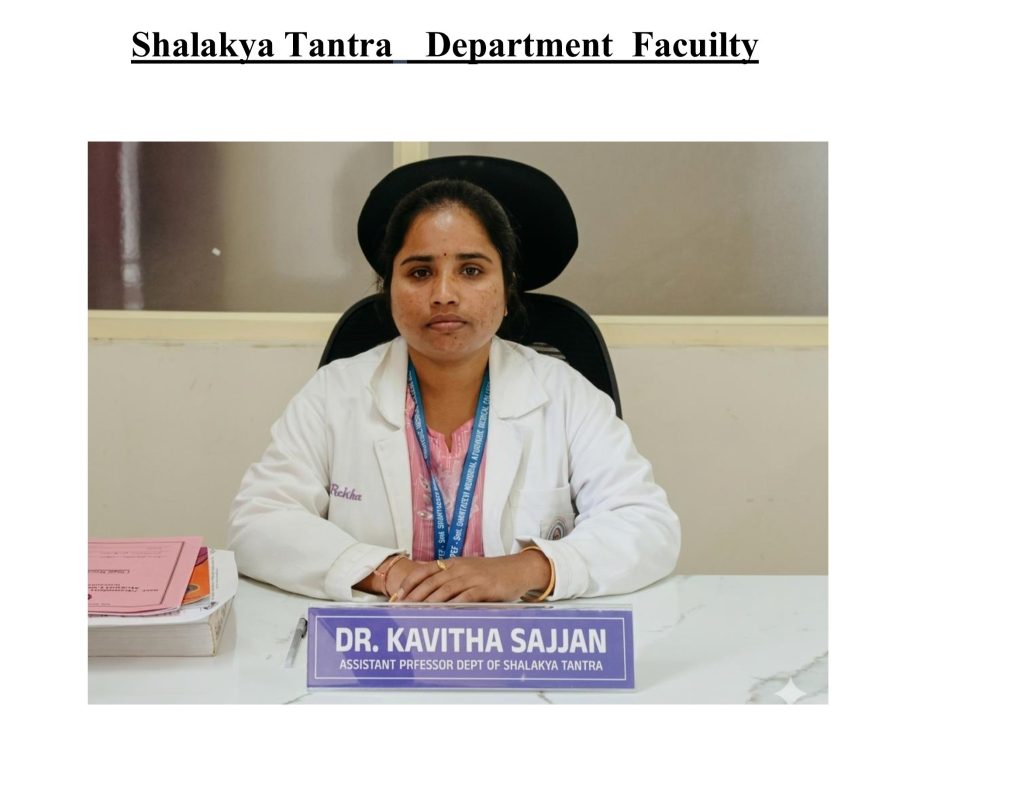
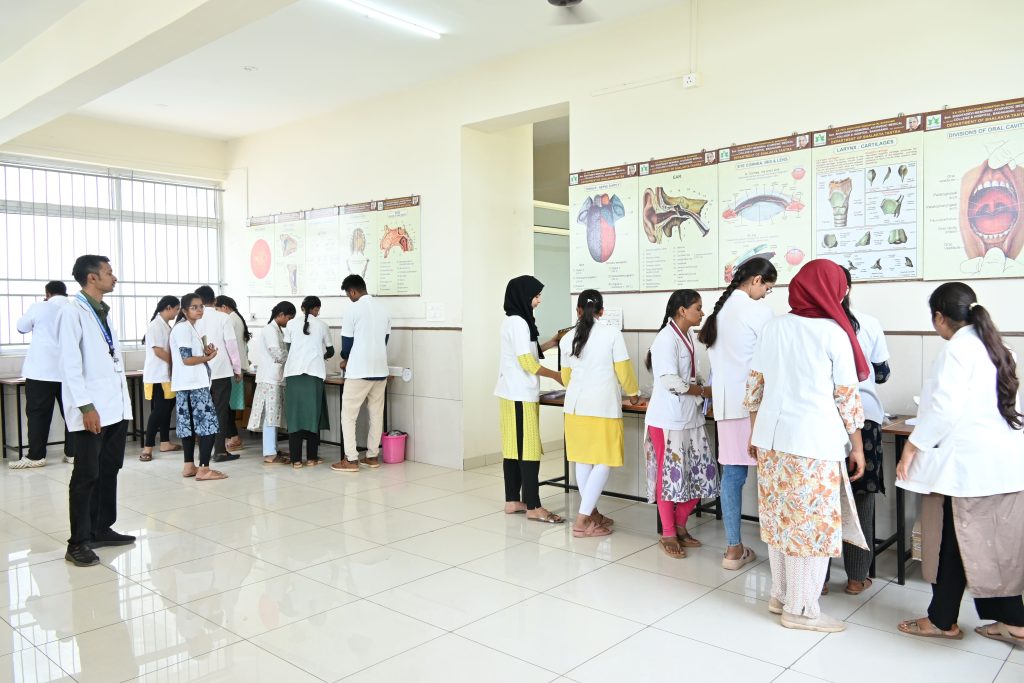
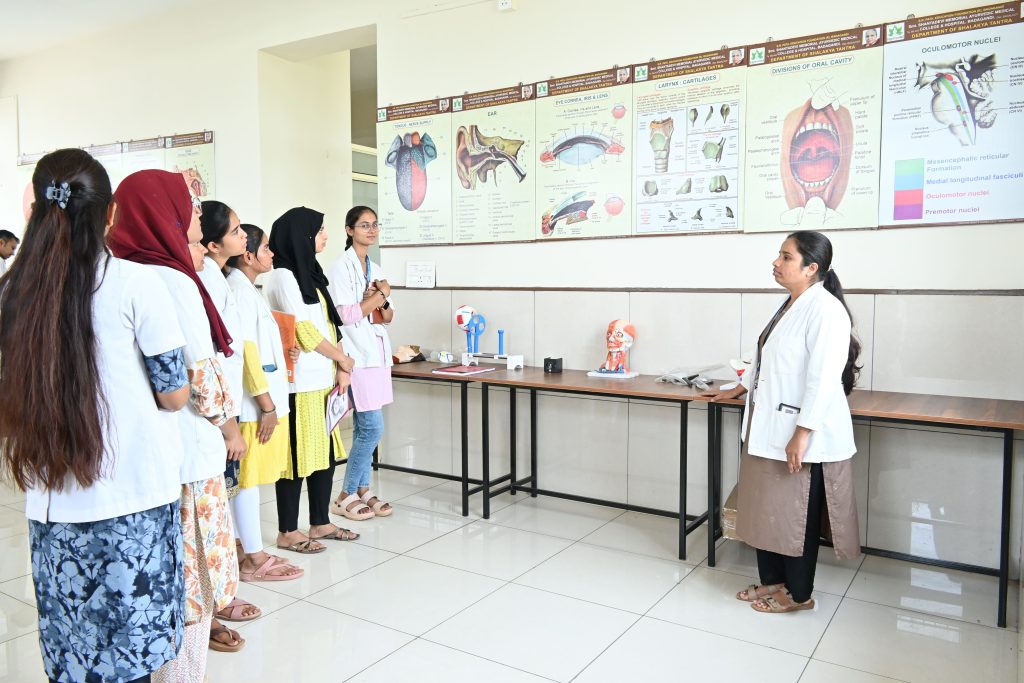
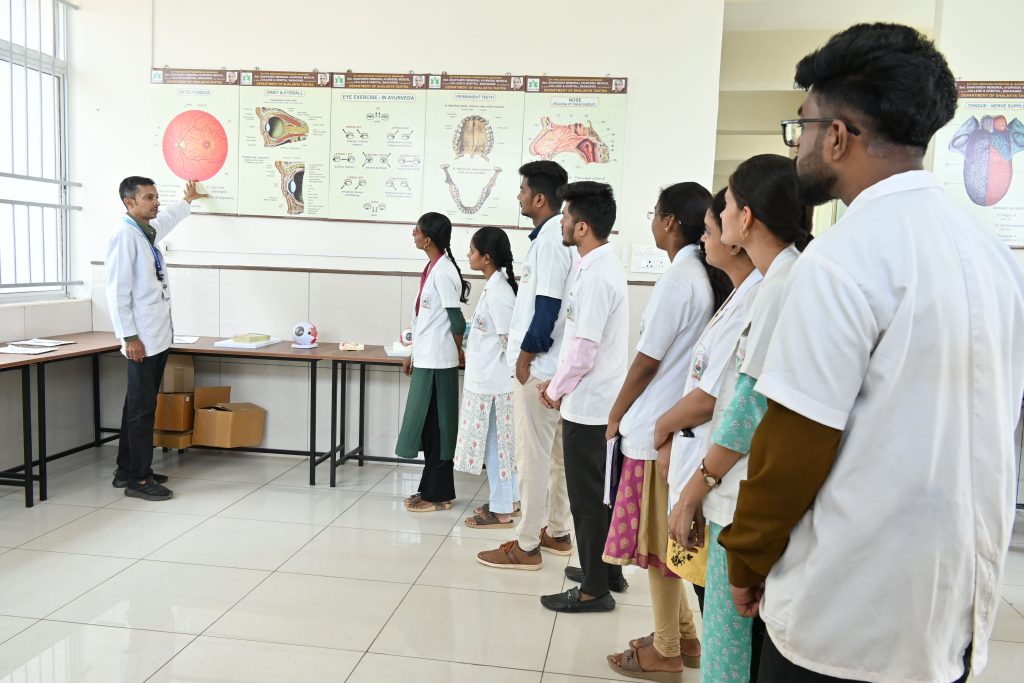
The department of Shalakyatantra deals with understanding the pathophysiology, diagnosis and management of diseases occurring above the clavicle. Viz. Diseases of eyes, ears, nose, throat, head and neck. Since this branch of ayurveda deals with the most vulnerable and minute parts various specialized instruments and techniques are used for diagnosis and treatment. These structures are vulnerable to diseases which are progressive with complication by nature. So preserving the structure and functional integrity of parts above the clavicle is given prime importance in Ayurveda with daily routine, seasonal routine and seasonal cleansing for its sustainability.
Vision
Uttamangasya Samrakshanam
Mission
- Our efforts are dedicated to impart quality and value based education to raise the satisfaction level of all the students.
- Our strength is directed to create competent professionals and service to mankind
- Our endeavour is to provide all possible support to promote research and evidence based documentation
Departmental Initiatives
- Importance of Eye donation and Eye pledging
- One of Eye collection centre under the name Drishti Dhanvantari
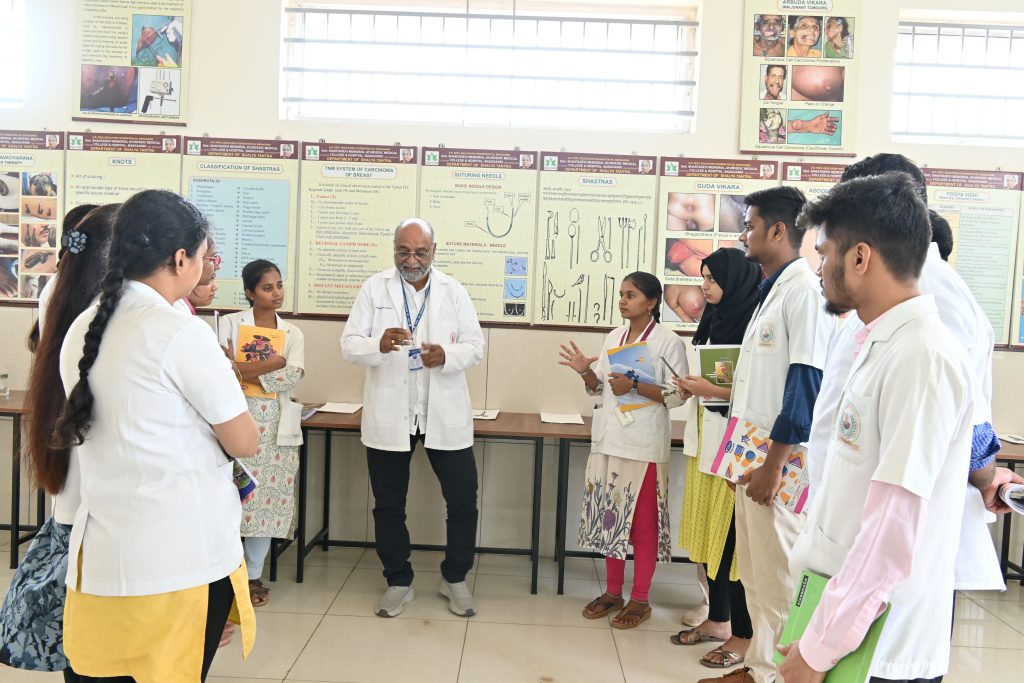
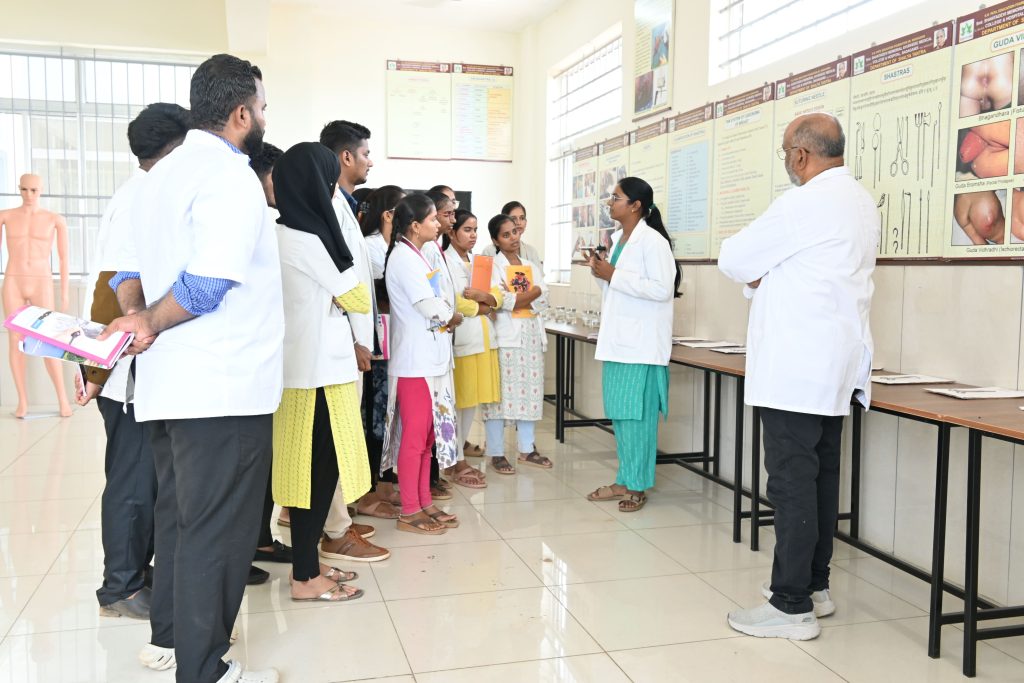
- Set with complete teaching aid as a part of Structural & functional understanding, Diagnostic and therapeutic approach through Models, Charts, Instruments and specimens
- Creating awareness about importance of Sense organs and treatment in Ayurveda through Camps, Talks in institution and public awareness programs
- Guest lectures from different field for thorough knowledge of diagnosis and treatment
- Hand on training on Kriyakalpa, Sthanika upakrama, and Parasurgical procedures during practical classes.
- Case taking and case presentation with day to day follow-up are given importance for each and every student to excel them in treating the speciality cases
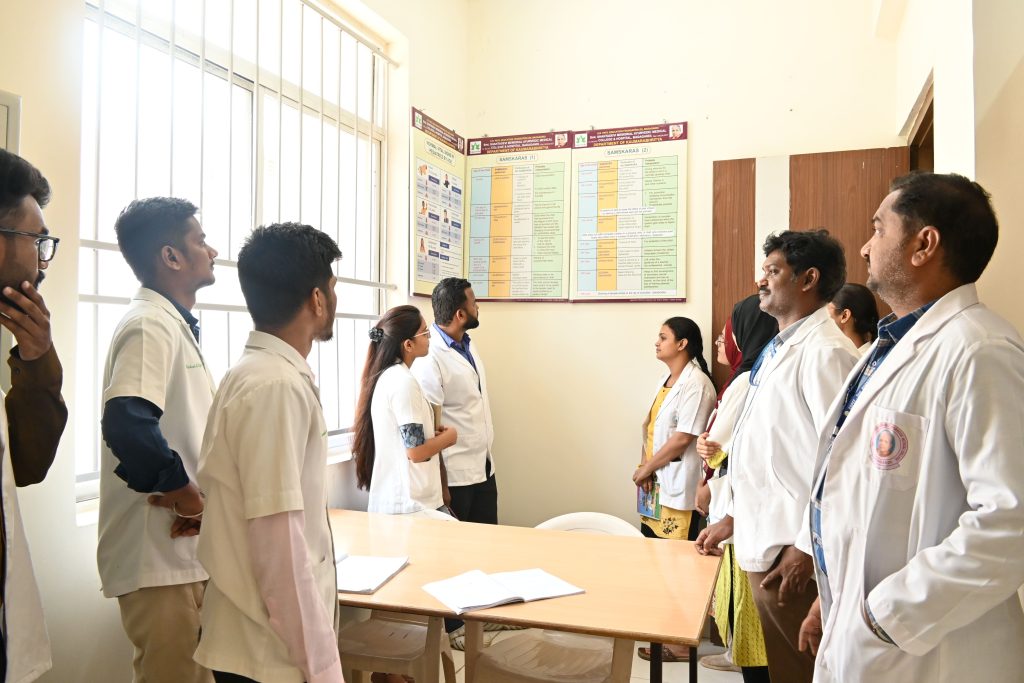
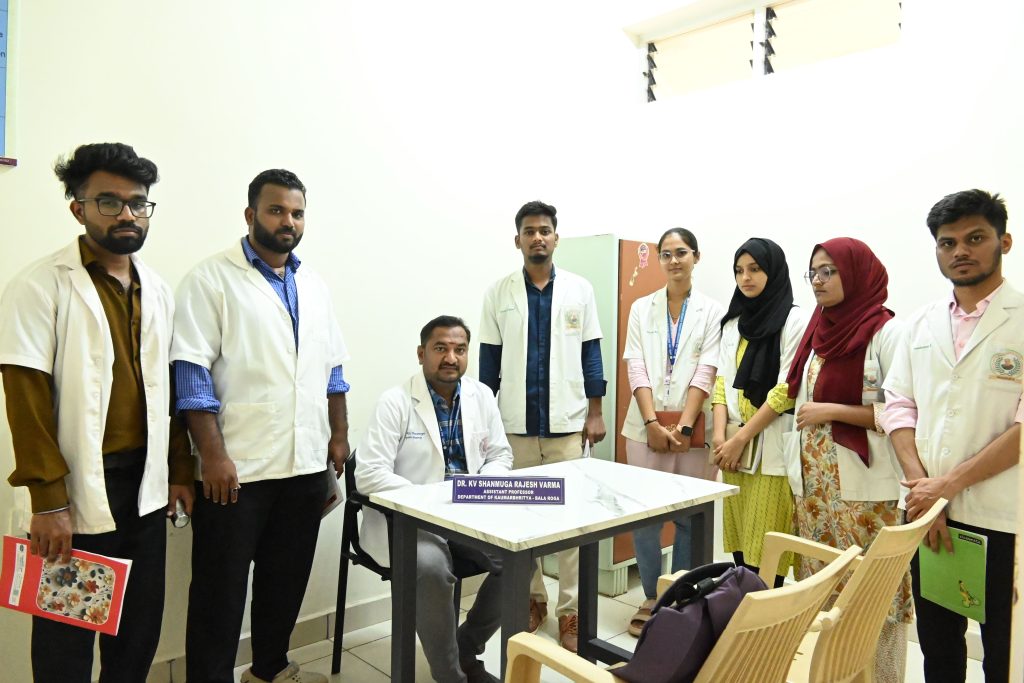
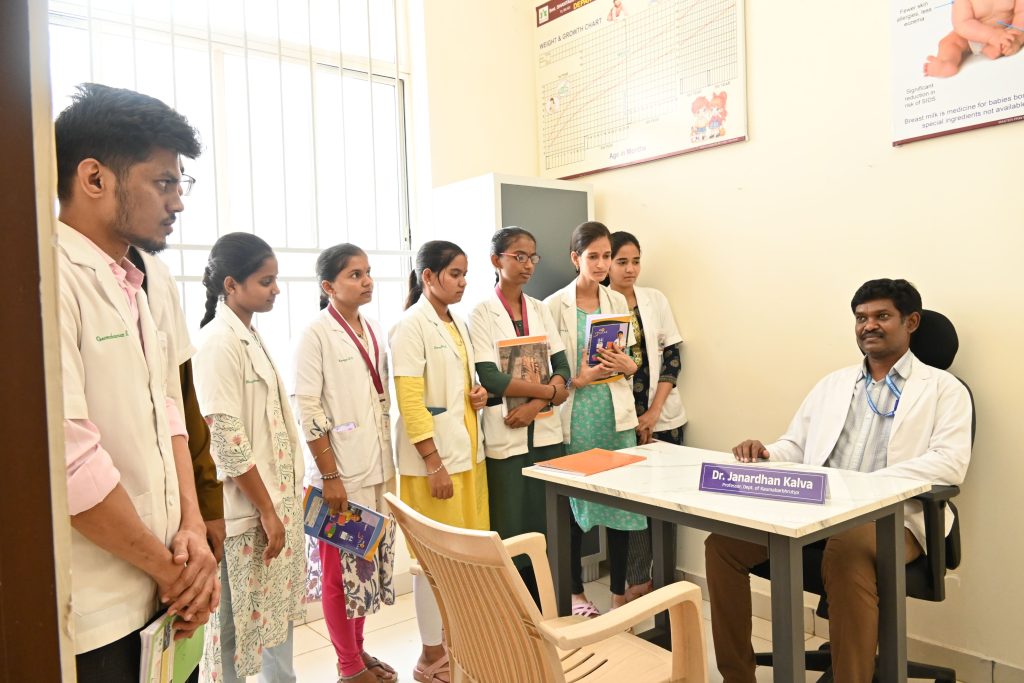
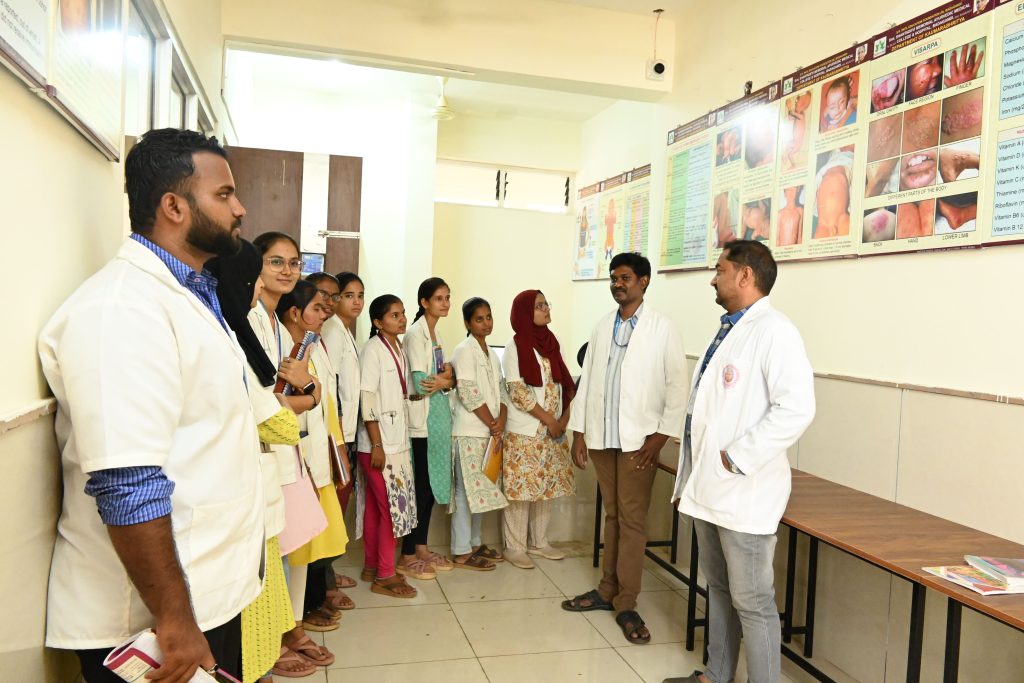
13 ) Department of Kaumarabhritya Bala Roga
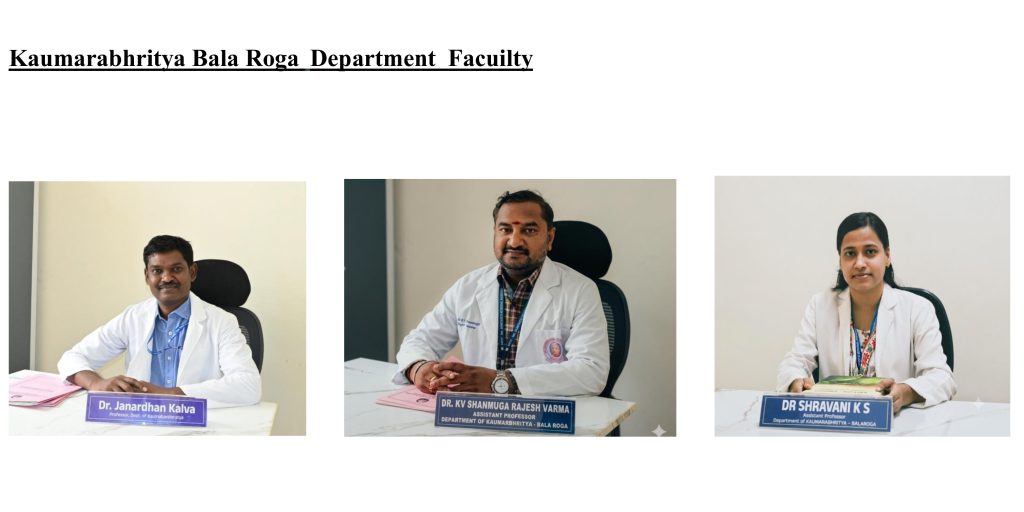
Kaumarabhritya department aims at improving the health of the children across the globe with upliftment of future population . Department provides an academic and clinical learning experience about the common problem encountered in navajatha shishu, Bala and Kumara that will enable scholars to be competent in Child health care system. Department also supports creative learning , research activity and community health activities.
Vision
To create a community with adept, prospective and responsive parenthood through healthy children and adolescents
Mission
- To create a healthy generation through novel native evidence based child care practices.
- To improve nutrition, immunity and health through time tested Ayurvedic resources
- To achieve academic excellence in Kaumarabhritya
- To promote clinical practice of Kaumarabhritya
- To treat common childhood illnesses through simple Ayurvedic Medicines• To develop evidence based research data on various practices of Kaumarabhritya
- To develop globally acceptable standard treatment protocols.
Departmental Initiatives
- Providing immunity boosters including swarnamrutha prashana
- Disease specific yogasana for children
- Nutritional care
- Adolescent education
- Training in basic life saving measures
- Encouraging for student research projects, Publication and scientific presentation
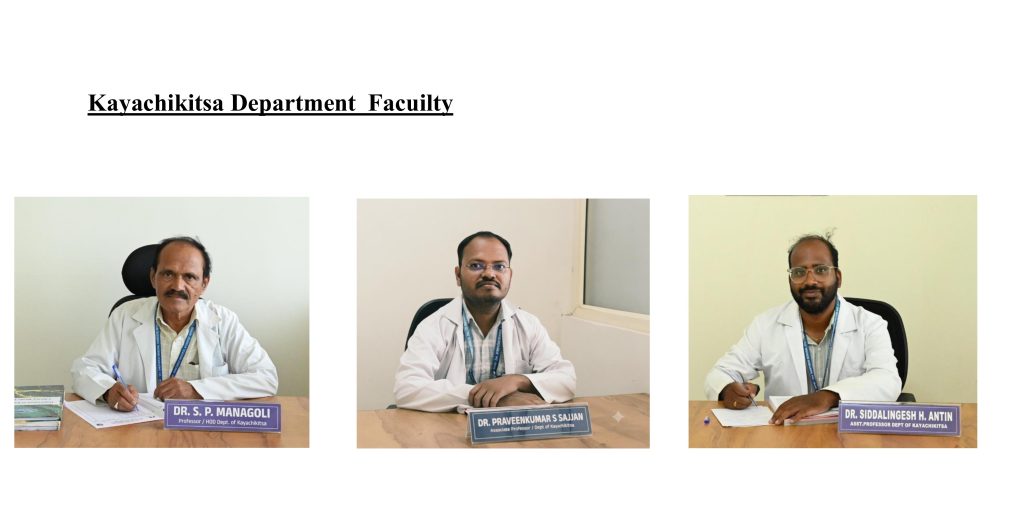
14 ) Department of Kayachikitsa
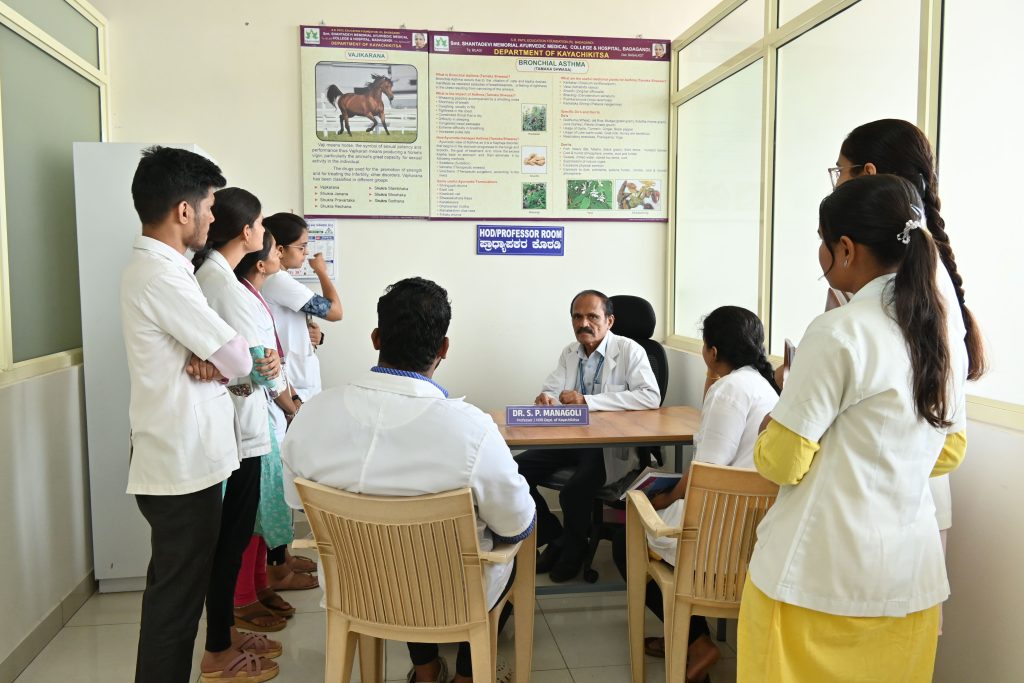
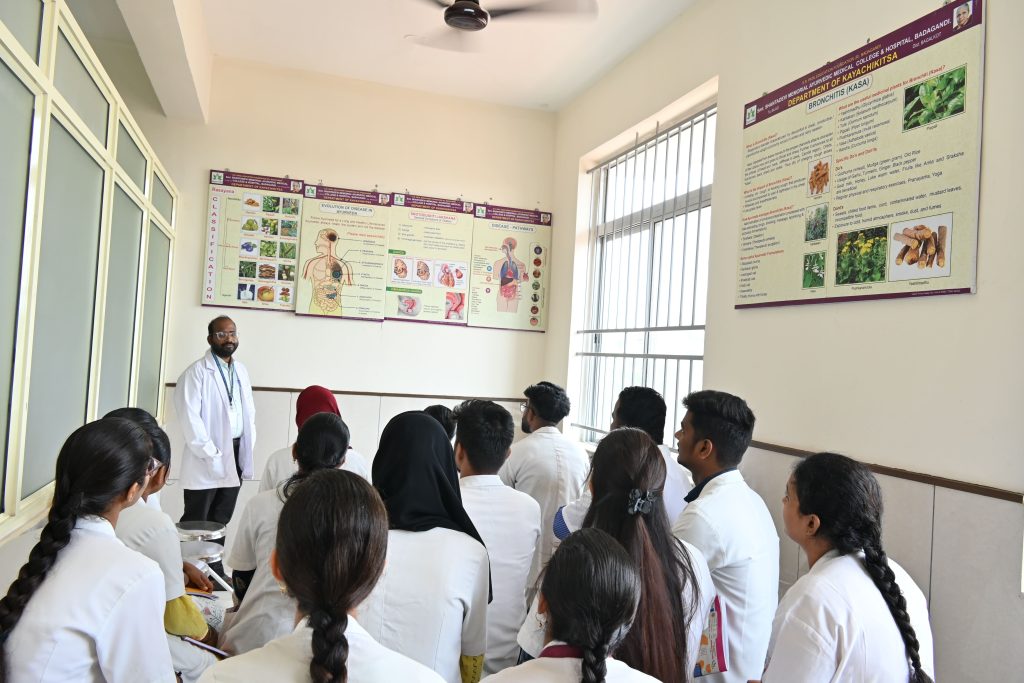
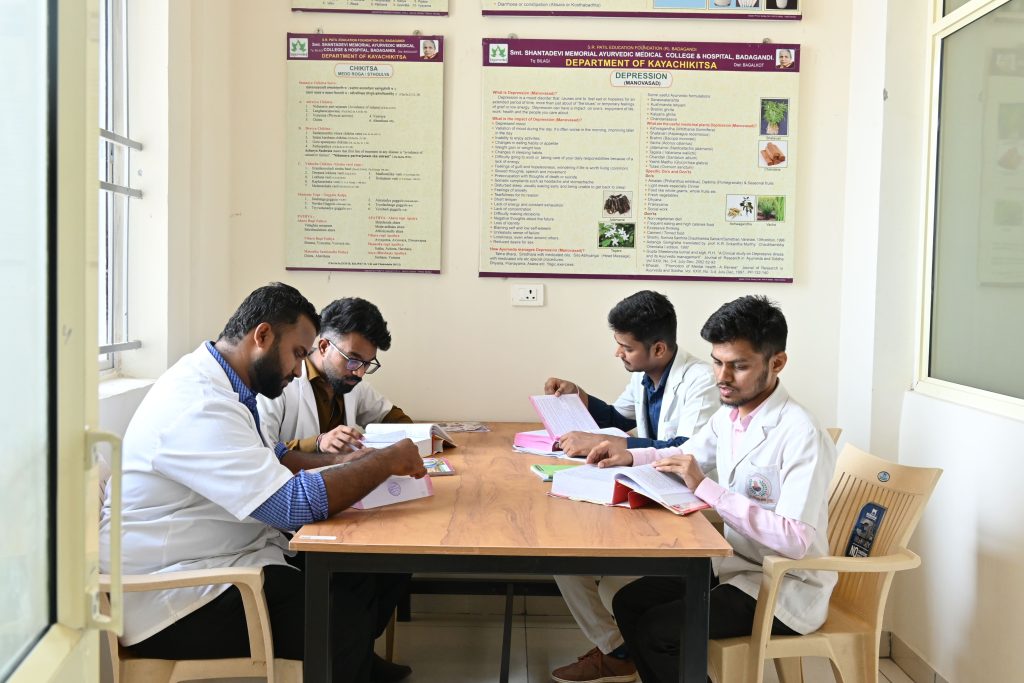
Kayachikitsa Department incorporates the Manasaroga, Rasayana and Vajeekarana under its hood. Kayachikitsa deals with treating of Shareerika rogas (Diseases afflicting the Body) from fever to various chronic maladies from its root cause. The Mansaroga deals with treatment ofvarious pschylogical conditions pertaining to manas. Rasayana Chikitsa focuses on the rejuvenation of the body and mind, and thereby one can have a healthy long life.Rasayana concentrates to delay the aging process and also provides the necessary care and nourishment to the Geriatric conditions. Vajikarana emphasis on treating infertility and such other conditions which inhibit the couples from having a healthy progeny. The Departmental front focuses to provide classical knowledge of the diseases and its management to the students. Department Library is enriched with more than 80 books for the benefit of staff and students. Relative number of informative Charts, specimens and models are available in the department.
Vision
To rejuvenate the body, ignite the mind and revitalise the spirit.
There by uplift the prinicple of Ayurveda ‘aathurasya vikara prashamanam cha roganruth.
Mission
Holistic approach towards the infirmity with comprehensive treatment, imparting medical education and clinical skills par excellence.
Bringing up compassianate Doctors of Ayurveda to the society.
To promote evidence based research activity.
Departmental Initiatives
To train the students to be excellent clinicians who can provide the comprehensive care to the patient.
To provide comprehensive care to the patients with the multiple problems bringing in relief from pain and sufferings, promotion of health and prevention of diseases and cure of the diseases where possible and care of those diseases which cannot be cured.